
Retargeting Ads on Meta 2026 are the Best Ads in History - Tutorial
How Do I Set Up Retargeting Campaigns That Convert?
If you Prefer Video, We Filmed This Just For You.
This video showcases all the information from this article, but in a video format!
Key Takeaways
Retargeting works because frequency compounds belief.
Most users do not convert after a single ad interaction. Retargeting campaigns increase exposure frequency, allowing messaging to build trust, address objections, and convert a larger percentage of the same audience.
Conversion efficiency improves when messaging matches awareness stage.
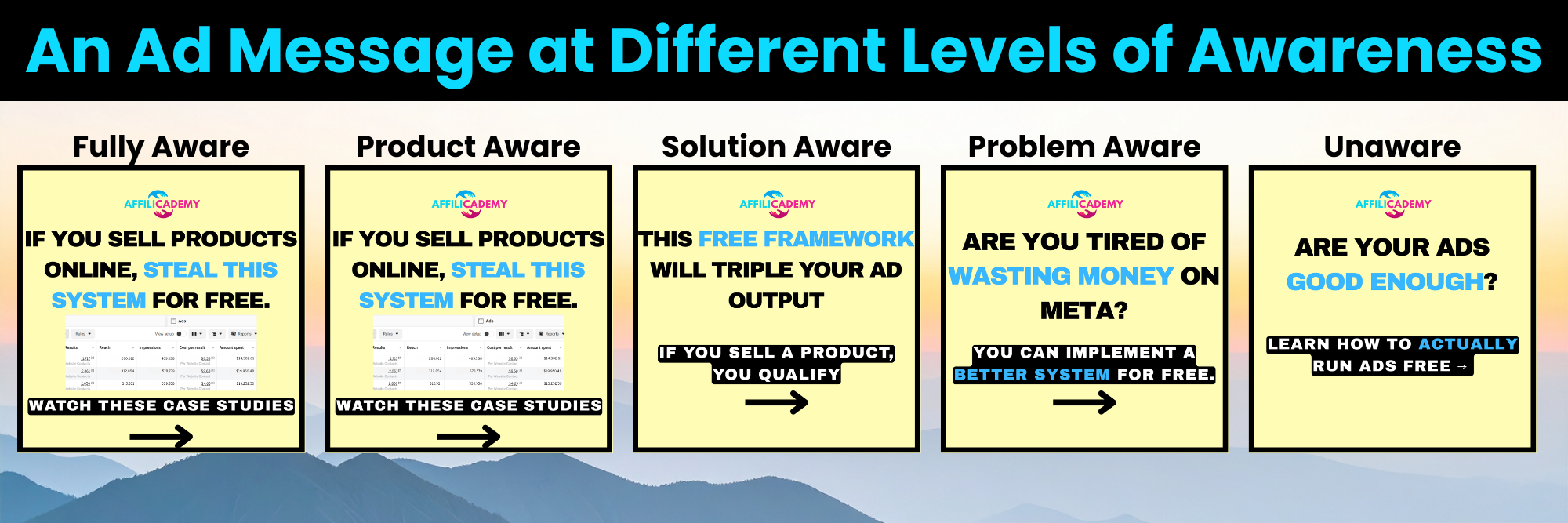
Cold audiences require education. Warm audiences require proof and differentiation. Retargeting ads work best when each exposure moves the user further along the 5 levels of awareness. (Unaware, Problem Aware, Solution Aware, Product Aware, Fully Aware) Explained with this article.
Creatives determines retargeting profitability.
If the same ad repeats endlessly, frequency produces fatigue rather than persuasion. Retargeting systems must rotate structured creative variations to maintain engagement.
Signal density drives effective optimization.
Platforms like Meta optimize based on performance clusters across creative variations. High creative density allows the algorithm to identify which retargeting ads generate the strongest conversion signals.
Scaling retargeting requires systems, not tactics.
Operators who treat retargeting as a simple campaign setting often plateau quickly. High-performing ecommerce remarketing campaigns rely on structured testing, awareness segmentation, and disciplined iteration cycles.
The Core Mechanism Behind Retargeting Campaigns That Convert
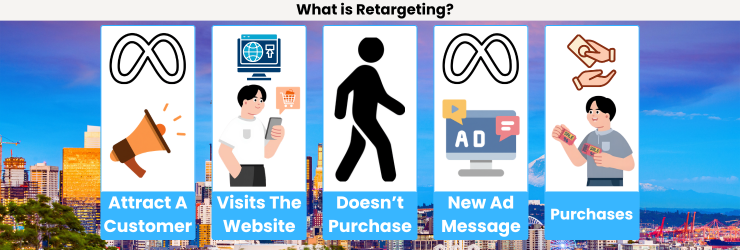
Retargeting is the system you can use on meta to increase the number of times an average person has seen your ad within a group. If you retarget based on levels of awareness, you can use this to increase familiarity, reduce the feeling of risk, and increase the number of conversions.
Consider how purchasing decisions actually occur in the real world. A consumer rarely buys the first time they encounter a product. They research, compare options, read reviews, and return multiple times before making a decision.
Retargeting campaigns replicate this natural decision-making process.
Instead of relying on a single advertisement to generate immediate conversion, the system allows multiple exposures to progressively strengthen the conversion signal.
According to the core philosophy behind profitable advertising systems, messaging must match the awareness level of the audience. Cold audiences require education, while warm audiences require proof and differentiation. If you send cold audiences who have never heard of you discount offers, they have no reason to convert because they do not have the trust needed.
Retargeting campaigns operate in the product aware and fully aware levels of awareness.
Users have already demonstrated interest. They may have visited the product page, watched a video, or engaged with social content.
Effective retargeting ads therefore emphasize:
Social proof
Customer testimonials
Product demonstrations
Before-and-after transformations
Competitive comparisons
Guarantees or risk reversal
This is important for getting retargeting campaigns that convert because conversion probability increases when repeated exposures progressively strengthen belief in the offer.
Common Structural Mistakes and Misconceptions
Understanding these mistakes is critical for building high-performing retargeting ads.
Mistake 1: Treating Retargeting as a Single Campaign
Many advertisers create one retargeting audience and show the same advertisement repeatedly.
At first, performance appears strong because the audience is highly qualified. However, as frequency increases, engagement signals decline and CPA begins to rise.
This occurs because the message remains static while audience exposure increases, instead of creating new angles and messages for the viewer to see.
The first exposure may focus on product education. The next highlights social proof. The third introduces risk reduction.
Each exposure advances persuasion rather than repeating the same message.
Mistake 2: Insufficient Creative Volume
One of the most common operational failures in advertising systems is insufficient creative density.
Platforms optimize based on performance clusters across multiple variations. When advertisers only test a few creatives, the algorithm cannot identify reliable performance signals.
Structured systems solve this through controlled creative variation.
For example:
3 offers × 2 hooks × 3 scripts × 4 visual formats
This produces dozens of potential creative variations from a single concept. Higher variation increases the probability of identifying high-performing retargeting ads.
Mistake 3: Random Testing Without Variable Isolation
Many operators experiment with new retargeting ads by changing multiple variables simultaneously.
Hook, message angle, visuals, and offer may all change at once.
When performance improves or declines, the operator cannot determine which variable caused the change, and therefore can't improve over time.
The Correct Strategic Framework
High-performing retargeting campaigns operate inside a structured advertising system rather than as isolated tactics.
The foundation of this system aligns closely with the philosophy used in scalable advertising frameworks: validation before expansion, creative density before budget increases, and disciplined iteration cycles.
The first component is precise audience segmentation.
Retargeting audiences should be categorized based on behavioral signals such as video engagement, website visits, product page views, and add-to-cart events. Each category represents a different awareness stage and requires different messaging.
The second component is message-to-awareness alignment.
Warm audiences require proof-based messaging rather than introductory explanations. Retargeting ads should emphasize testimonials, case studies, demonstrations, and competitive differentiation.
The third component is structured creative testing.
Instead of relying on a single advertisement, campaigns should deploy multiple variations built around different hooks, scripts, and visuals. Higher creative density increases signal generation and allows the platform to identify performance clusters.
The fourth component is defined validation thresholds.
Scaling decisions should only occur after an ad has produced statistically meaningful performance signals. Increasing spend prematurely introduces volatility and reduces system stability.
The fifth component is iteration-driven scaling.
Rather than scaling individual ads, high-performing systems scale creative ecosystems. Winning concepts are expanded into additional variations, while underperforming creatives are replaced.
When these components operate together, retargeting works.
I Will Setup Your Retargeting Ads, For Free
If you think retargeting ads are right for your business, and you want someone to set them up for you, for free, and then on a performance basis after they work, fill out the form below. https://affilicademy.com/10freeugc

FAQ
What are the benefits of using retargeting ads?
Retargeting ads allow you to re-engage users who have already interacted with your brand. Because these audiences are warmer than cold traffic, conversion rates are typically much higher and customer acquisition costs are lower.
What should I avoid when creating retargeting ads?
Avoid repeating the same creative indefinitely. High frequency combined with low creative variation causes engagement signals to decline and performance to collapse.
What is the difference between retargeting and remarketing?
Retargeting typically refers to digital advertising that targets previous visitors through platforms like Meta or Google. Remarketing often refers to follow-up communication such as email campaigns targeting previous visitors or customers.
How much does retargeting cost?
Retargeting typically costs less per conversion than cold acquisition campaigns because the audience has already demonstrated interest. However, costs increase if creative fatigue occurs or if the audience size becomes too small.
How do I improve retargeting ads?
Improve retargeting ads by increasing creative variation, aligning messaging with awareness stage, segmenting audiences based on behavior, and introducing structured iteration cycles to prevent creative fatigue.