Why SCALER Improves Ad Performance
What Is the SCALER Framework and How Does It Improve Ad Performance?
Key Takeaways
1. The SCALER framework is a performance math model, not a creative philosophy.
It calculates required ad volume, hit rate, and capacity before scaling, aligning spend with statistically validated performance thresholds.
2. Scaling in ads is a capacity problem, not a budget problem.
Increasing spend without increasing validated creative volume compresses frequency, reduces hit rate, and destabilizes performance.
3. Meta’s Andromeda algorithm rewards structured signal density.
High creative volume, controlled variable testing, and strict threshold enforcement outperform random experimentation and reactive optimization.
4. Predictable Facebook ad targeting performance requires iteration cycles before expansion.
SCALER enforces validation before aggressive spend, protecting margin and compounding conversion efficiency over time.
5. The correct budget optimization when scaling winning ads depends on structural stability.
Advantage Campaign Budget (CBO) can accelerate performance only after controlled validation confirms hit rate durability.
1. Introduction: The SCALER Framework Is an Operating System, Not a Tactic
Most operators searching “What is the SCALER framework and how does it improve ad performance?” assume it is a creative checklist or scaling trick.
It is neither.
The real issue in modern paid acquisition, especially on Facebook and Instagram, is structural misalignment between strategy and Meta’s Andromeda algorithm. Andromeda prioritizes creative volume, conversion efficiency, and creative iteration velocity. Most advertisers optimize surface metrics while ignoring systemic constraints.
They increase budget without increasing validated ad capacity.
They test inconsistently.
They shift targeting variables mid-test.
They scale before confirming statistical durability.
The result is volatility masked as progress.
SCALER exists to solve this structural instability. It reframes advertising as a constrained system governed by:
Required hit rate
Ad capacity per spend level
Defined success thresholds
Controlled testing matrices
Profit-based reinvestment logic
Instead of asking “How do I scale this winning ad?”, SCALER asks:
What hit rate is required to sustain this spend?
How many new creatives must be produced to statistically support that hit rate?
What volume is necessary to maintain performance stability as frequency rises?
This shifts Facebook ad targeting from guesswork to engineering.
It converts creative from artistic output into capacity infrastructure.
It replaces reactive scaling with calculated scaling.
When understood correctly, SCALER is less about increasing ROAS and more about building a system that makes ROAS predictable under expansion.
This is important for getting improved ad performance using the SCALER framework because stable scaling requires structural alignment with Meta’s algorithm rather than tactical improvisation.
2. The Core Mechanism Behind the SCALER Framework
To understand what the SCALER framework is and how it improves ad performance, you must understand the core causal chain:
Message-to-market alignment → Signal density → Conversion efficiency → Profit stability → Scalable spend
The algorithm does not reward creativity alone. It rewards validated performance at volume.
Creative Volume and Signal Density as the Core Lever
Meta’s Andromeda system processes massive behavioral data in real time. It identifies high-conversion micro-signals across audiences. But it can only optimize efficiently when given enough statistically meaningful inputs.
Low creative volume produces weak signal density.
Weak signal density increases volatility.
Volatility reduces algorithmic confidence.
Reduced confidence increases CAC variability.
SCALER increases signal density by requiring a defined ad volume based on expected hit rate.
If your hit rate is 20%, and you require 5 scalable winners, you must produce 25 creatives.
This eliminates emotional bias in creative selection.
Structured Testing and Variable Isolation
Random experimentation creates variable chaos.
If targeting, copy, hook, and format change simultaneously, performance attribution collapses. You cannot determine causality.
SCALER enforces:
One ICP per campaign
One core problem per ad set
Controlled variable testing
Strict evaluation thresholds
This builds clean data loops.
Threshold Enforcement
Many operators “scale” ads that are barely profitable at low spend.
SCALER defines minimum CTR, conversion rate, and margin thresholds before scale is permitted. Ads that do not exceed structural baselines are replaced, not optimized reactively.
This protects the system from scaling inefficiency.
The improvement in ad performance does not come from clever hooks. It comes from increasing validated signal input into Meta’s optimization engine while enforcing economic thresholds that prevent margin collapse.
This is important for getting improved ad performance using the SCALER framework because conversion efficiency compounds only when creative volume and hit rate are mathematically aligned with spend.
3. Common Structural Mistakes and Misconceptions
Most advertisers do not fail due to lack of effort. They fail due to structural miscalculation.
Mistake 1: Scaling Before Validating Hit Rate
Operators see early ROAS success and increase budget aggressively.
At low spend, almost any competent ad can perform. Audience saturation is minimal. Frequency is low. The algorithm has abundant room to optimize.
At higher spend, performance compresses.
If hit rate is not durable across multiple creatives, scaling exposes fragility.
Under SCALER, validation requires multiple ads exceeding threshold performance before expansion. One winner is not capacity.
Scaling without hit rate durability reduces performance stability and increases CAC variance.
Mistake 2: Treating Facebook Ad Targeting as the Primary Lever
Many advertisers obsess over interest stacks and audience exclusions.
Under Andromeda, broad targeting with strong creative often outperforms micro-segmentation. The algorithm identifies buyers more efficiently than manual layering when given sufficient signal.
SCALER shifts emphasis from audience manipulation to creative capacity and message precision.
Targeting supports structure. It does not replace it.
Mistake 3: Optimizing Losing Ads Instead of Replacing Them
Reactive optimization, specifically changing headlines, adjusting budgets, tweaking copy, creates data contamination.
If an ad does not meet threshold criteria within defined spend parameters, it is replaced.
But you wait until the data comes through.
This maintains data clarity and prevents sunk-cost bias.
Mistake 4: Ignoring Capacity Mismatch
Advertisers increase daily spend without increasing creative output.
Creative fatigue accelerates. Frequency rises. CTR declines. CAC increases.
Without new validated ads entering rotation, the system cannibalizes itself.
This is important for getting improved ad performance using the SCALER framework because eliminating structural instability increases hit rate durability and protects margin during scaling.
4. Why Most Efforts Collapse at Scale
What is scaling in ads?
Scaling in ads is the process of increasing spend while maintaining or improving return metrics such as CAC and ROAS.
What is scaling in marketing?
Scaling in marketing is expanding customer acquisition volume without proportionally increasing inefficiency.
The collapse happens when spend rises faster than validated creative capacity.
Creative Fatigue and Frequency Compression
At low spend, frequency remains manageable.
At higher spend, audience exposure increases rapidly.
If creative volume does not expand, CTR declines due to fatigue. Lower CTR reduces engagement signals. Algorithmic confidence drops. CPM may increase. CAC rises.
Declining Hit Rate at Volume
Hit rate often decreases as testing volume increases without structured iteration. If creative production is inconsistent, the number of winners per batch declines.
SCALER counters this by defining required ad volume relative to spend targets.
If you plan to double spend, you must increase creative output proportionally to maintain hit rate stability.
Budget Optimization During Scaling
Which budget optimization would you use when scaling winning ads?
Under structural stability, Advantage Campaign Budget (CBO) allows Meta to allocate spend dynamically across validated ad sets.
However, if creative durability is uncertain, scaling at the ad set level with controlled spend increments preserves data integrity.
CBO is a scaling accelerator, not a diagnostic tool.
Most efforts collapse because scaling is treated as financial expansion rather than creative capacity expansion.
This is important for getting improved ad performance using the SCALER framework because sustainable scaling depends on maintaining hit rate and signal density as spend increases.
5. The Correct Strategic Framework: SCALER in Practice
The SCALER framework formalizes scaling as a structured system governed by mathematical constraints.
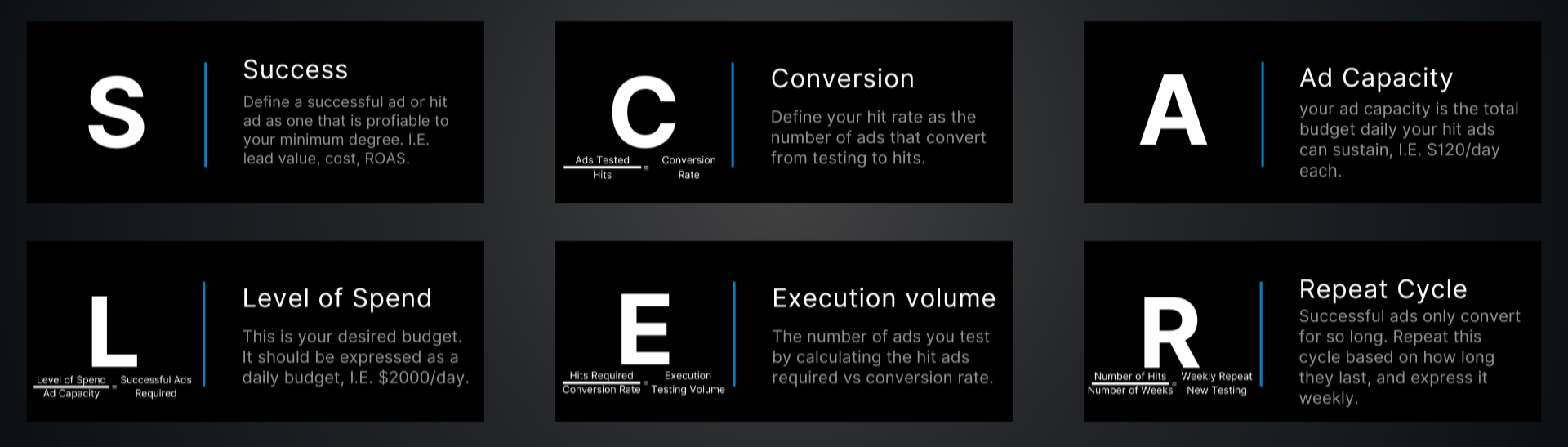
While the acronym components operate as an integrated loop, the governing logic includes:
Defined Success Metrics
Before scaling, define:
Target CAC
Required margin
Minimum CTR
Minimum conversion rate
Required hit rate per batch
Without numeric baselines, scale becomes subjective.
Ad Capacity Calculation
Determine:
Target spend ÷ acceptable CAC = required daily conversions.
Required conversions ÷ historical conversion rate = required traffic volume.
Required traffic ÷ expected CTR = required impression volume.
Then calculate required creative volume to sustain CTR at scale.
Creative output must support this projected exposure.
Controlled Creative Testing Matrix
Each batch isolates:
One ICP
One core problem
One message type
One creative format
This produces clean data.
Iteration cycles prioritize new angles over edits.
Profit-Funded Reinvestment
Scaling is funded by validated margin.
Profitable campaigns reinvest into creative production capacity.
More creative increases hit rate probability.
Higher hit rate reduces blended CAC.
Lower CAC increases margin.
Margin funds more creative.
SCALER transforms Facebook ad targeting into a system aligned with algorithmic optimization rather than manual micromanagement.
Predictability emerges from structured iteration and capacity scaling.
This is important for getting improved ad performance using the SCALER framework because mathematical alignment between creative volume, hit rate, and spend eliminates scaling volatility.
6. Strategic Synthesis
The SCALER framework answers the question “What is the SCALER framework and how does it improve ad performance?” by reframing advertising as an engineering problem.
Success is structural.
Predictability comes from systems.
Meta’s Andromeda algorithm rewards signal density, validated creative, and economic durability.
Scaling is not increasing budget.
Scaling is increasing validated creative capacity while maintaining hit rate.
Operators who internalize this stop chasing hacks and start managing throughput.
They calculate required ad volume.
They enforce thresholds.
They iterate before expanding.
They use budget optimization tools only after structural validation.
Ad performance improves not because creativity improves, but because system constraints are respected.
This is important for getting improved ad performance using the SCALER framework because disciplined structural alignment with Meta’s algorithm converts creative testing from a gamble into a predictable scaling engine.
Affilicademy Also Implements this for Free.
If you don't want to spend the time to learn it, but do want:
-10 free static ads
-10 free UGC videos
-Free ad management
-Full setup with no retainer
Click the link and take the 10 minute call with Elias.
FAQ
What is the SCALER framework in simple terms?
It is a structured scaling system that calculates required creative volume and hit rate before increasing spend, aligning ad capacity with economic thresholds.
What is scaling in ads?
Scaling in ads means increasing budget while maintaining stable CAC and margin, which requires proportional increases in validated creative capacity.
What is scaling in marketing?
Scaling in marketing is expanding acquisition volume without increasing inefficiency, achieved through systemized iteration and margin-protected reinvestment.
Which budget optimization should I use when scaling winning ads?
Use ad set-level scaling during validation. Transition to Advantage Campaign Budget once multiple creatives exceed performance thresholds and durability is confirmed.
How does Facebook ad targeting fit into SCALER?
Targeting supports structure but does not replace creative validation. Broad targeting combined with high creative volume typically outperforms micro-segmentation under Meta’s Andromeda system.
Why do most Facebook ads fail at higher spend?
Because creative capacity does not increase with budget, reducing hit rate and compressing performance stability.
How do I calculate required creative volume?
Divide desired spend by acceptable CAC to determine required conversions, then reverse-engineer traffic and impression requirements, and produce enough creatives to sustain CTR at projected frequency levels.