How to Convert Cold Viewers on Meta
Key Takeaways
Cold audiences are converted by using ads that start their journey to understanding why to purchase instead of offers.
If the message does not match the user’s level of awareness, conversion rates collapse regardless of audience quality.
Most cold traffic fails because it is asked to convert before understanding the problem.
Users must first recognize a symptom, then understand the underlying issue, before evaluating solutions.
The creative strategy for this article is going to use that to showcase a system you can implement on Meta ads.
If you Prefer to Watch a Video, you are in Luck!
Introduction
Targeting cold audiences on social media is a problem of communicating with people who do not yet understand why they should care.
The correct question is “How do you structure a system that converts unaware users into informed buyers?”
You do this by starting at the beginning of the customer journey. The first symptom you experience.
The Core Mechanism Behind Cold Audience Targeting
Users entering a cold campaign exist across a spectrum:
Unaware of the problem
Aware of symptoms but not the cause
Aware of the problem but not solutions
Aware of solutions but not your offer
Aware of your offer
Most campaigns fail because they compress these stages into a single interaction.
From a system perspective, this creates low engagement, weak signal density, and poor optimization. The algorithm receives insufficient feedback to refine delivery, resulting in high CPMs and unstable CPA.
Effective cold targeting starts by identifying a symptom-level entry point, which acts as a relatable experience that signals a hidden problem. This increases engagement, which improves signal density, allowing the algorithm to identify similar users.
The mechanism is cyclical:
Better awareness alignment → higher engagement → stronger signals → improved delivery → lower acquisition cost.
Cold Audience Funnel Architecture (Ad → Landing Page → Conversion Path)
Cold audience systems require a in depth funnel to successfully convert a potential customer.
The ad functions as a pattern interrupt and symptom identifier. Its purpose is not to sell, but to create recognition. Effective ads ask implicitly or explicitly: “Have you experienced this?”
The landing page performs the education layer. It explains:
Why the symptom exists
What underlying problem causes it
Why it remains unresolved for most people
Only after this foundation is established should the solution be introduced.
The final section of the funnel presents the conversion mechanism, typically framed as a next step rather than a hard sell. This reduces resistance because the user has already internalized the problem.
This architecture ensures that each stage performs a single function within the system. When these roles are blended or skipped, conversion rates decline because users are asked to make decisions without sufficient context.
Why Audience Targeting Is Overvalued and Messaging Is Undervalued
Traditional targeting assumes that user attributes predict purchasing behavior. Modern systems demonstrate that behavioral response to messaging is a stronger signal.
Platforms like Meta optimize for engagement and conversions. When a user interacts with an ad, the system identifies patterns across thousands of variables that are not accessible to advertisers.
This means:
Broad targeting with strong messaging often outperforms narrow targeting with weak messaging
Creative performance determines audience expansion
Messaging acts as a filtering mechanism
Step By Step - How to Target Cold Audiences With an Ad Example.
An effective system follows a structured sequence.
First, define the core problem and its symptoms. This becomes the foundation of all messaging.
Second, build creatives that isolate single symptoms. Each ad should target one entry point into the problem, increasing clarity and engagement.
Third, design a landing page that expands the user’s understanding. Avoid introducing the solution prematurely.
Fourth, implement a testing system that evaluates:
Engagement rate (signal quality)
Conversion rate (funnel efficiency)
CPA (economic viability)
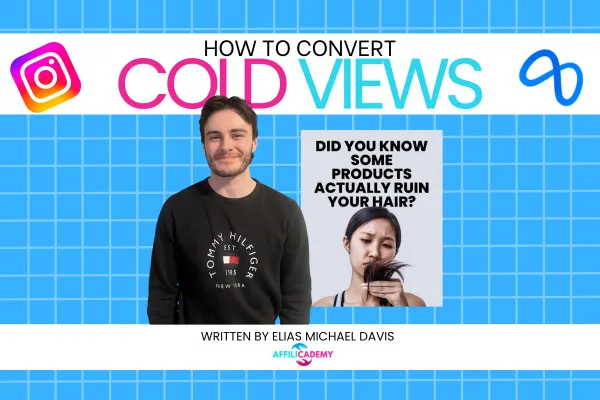
The finished ad should look like this. Very simple.

This ad generated a 6x CAC:LTV ratio in the first 90 days because it asked if the viewer knew why they were experiencing a symptom - dead hair. Then, it answered it on the landing page, and finally converted them through lead nurturing.
Conclusion
If you want to convert a cold audience you need to be able to identify the symptoms of the problem you solve.
If you want my help, on a free trial, then on a performance basis once it works, fill out the form below.
https://affilicademy.com/10freeugc

FAQ
How do you target specific audiences on social media?
You do not rely primarily on manual targeting. You use broad audiences and allow the algorithm to optimize delivery based on engagement and conversion signals generated by your creatives.
How can you target unaware audiences?
By focusing on symptom-based messaging that creates recognition without requiring prior knowledge of the problem or solution.
How do levels of awareness affect ad revenue?
Higher awareness increases conversion rates. Campaigns that move users from unaware to problem-aware expand total addressable demand and improve revenue scalability.
Should cold ads try to sell directly?
No. Cold ads should create awareness and drive users into an educational funnel where conversion becomes viable.
Glossary
Audience Expansion
The process by which algorithms deliver ads to broader user segments as campaigns scale.
Conversion Event
A tracked action that represents a desired outcome, such as a purchase or lead submission.
CPA (Cost Per Acquisition)
The average cost required to generate a single conversion.
CPM (Cost Per Thousand Impressions)
The cost of delivering 1,000 ad impressions.
Creative Fatigue
Performance decline caused by repeated exposure to the same ad creative.
Engagement
User interactions with an ad, including clicks, likes, shares, and comments.
Learning Phase
The period during which the algorithm gathers data to optimize ad delivery.
Organic Social Media
Unpaid content distribution through social platforms.
Paid Social Advertising
The use of paid campaigns to distribute content and acquire customers.
Signal Density
The volume and quality of data generated by user interactions, used for optimization.
Optimization
The process of improving campaign performance through data-driven adjustments.