A Full Guide to Know How Many Creatives to test on Meta. (2026 Andromeda)
How Many Ad Creatives Do I Need to Test Before Scaling?
The 5 Most Important Things to Remember:
1. Scaling Meta ads is primarily a creative capacity problem, not a budget problem.
Creative volume determines whether the algorithm can continue finding profitable pockets of demand. By testing more creatives, you can target more audiences.
2. A single winning ad does not create a scalable system.
One creative can only validate a specific message or problem type, sustainable scaling requires a repeatable testing pipeline that continuously generates new conversion signals.
3. Creative testing must operate as a controlled signal-generation system.
Without structured testing and threshold enforcement, it is impossible to know what the specific reasoning for an ad performing is.
4. Retargeting is part of the iteration cycle across awareness levels.
Top-of-funnel creative introduces the problem; retargeting layers progressively deepen awareness until purchase resistance collapses. By testing creatives at different levels of awareness, you can retarget effectively.
5. The number of creatives required before scaling depends on hit rate, iteration speed, and audience saturation thresholds.
Operators with structured testing systems may identify a scalable winner in 10–20 creatives, while chaotic testing environments may burn through hundreds without clear signal.
Introduction
The question “How many ad creatives do I need to test before scaling?” reflects a deeper structural misunderstanding of paid acquisition systems.
what you need to avoid is thinking of creative testing as a linear activity. Produce a few ads, run them in a campaign, identify the “winner,” and then increase the budget. When performance collapses at higher spend levels, the explanation is usually attributed to platform volatility, audience exhaustion, or algorithm unpredictability.
This is entirely incorrect.
Scaling paid acquisition is fundamentally a system design problem involving signal generation, iteration cycles, and creative capacity. The number of creatives required before scaling is not a fixed number because it emerges from the interaction between several structural components:
Creative testing volume
Message-to-market alignment
Signal density within the ad account
Conversion efficiency of the funnel
Audience awareness progression
Frequency thresholds across the funnel
If these components are not structurally aligned, no amount of creative production will generate predictable scaling outcomes.
In mature paid acquisition systems, testing never stops. Instead, creative testing becomes a continuous capacity engine that feeds the scaling mechanism. This effectively means when you find a winning ads it's just another day.
When advertisers ask how many creatives they need before scaling, what they are really asking is how much conversion signal must be generated before the system can reliably identify profitable demand segments.
Understanding this distinction is critical because it reframes creative testing from a content problem into a performance engineering process.
The remainder of this article will break down the mechanism behind scalable creative testing, explain why most advertisers misinterpret creative volume requirements, and outline a system-driven framework for testing and scaling Meta ads creatives using structured iteration and retargeting dynamics.
This is important for getting reliable Meta ad scaling outcomes because creative testing volume determines how much conversion signal the algorithm can use to locate profitable demand.
The Core Mechanism Behind Creative Volume and Scaling
At its core, the question “How many ad creatives do I need to test before scaling?” is a question about signal density inside a paid acquisition system.
Every advertising platform relies on probabilistic optimization. The algorithm does not understand products or messaging in a human sense. Instead, it interprets behavioral patterns generated by ad interactions and conversions.
Creative testing generates the signals that enable this pattern recognition.
If an advertiser launches a campaign with three creatives and one of them performs moderately well, the algorithm has extremely limited data to determine whether that result reflects:
True message-to-market alignment
Temporary engagement from a narrow audience segment
Random variance within the auction
This is why scaling based on a small creative sample size frequently leads to performance collapse.
A scalable advertising system requires structured signal generation, which emerges from several interconnected mechanisms.
First is message-to-market alignment. Each creative is essentially a hypothesis about a specific problem experienced by a specific audience. If the hypothesis resonates, engagement and conversion signals increase. If it does not, the system receives weak or inconsistent feedback. What this means in simplistic language is each ad you test can measure the interest of a specific problem, shown in a specific way, to one ICP.
Second is signal density, which refers to the volume of meaningful engagement and conversion events produced by testing multiple creatives. The higher the number of unique creative hypotheses tested, the greater the probability that the system will identify a high-performing message.
Third is creative capacity, which determines how quickly an advertiser can generate new hypotheses when performance declines or audiences expand. This is also related to how much money a creative can support. If your create stops performing at $500 per day when it performed at $100, it has limited creative capacity.
Fourth is threshold enforcement, which filters noise from signal. Without defined performance thresholds, advertisers often misinterpret random variation as success. This is measured by a specific cut off and success metric. "If the ad gets higher than a $9.25 CPA, it is a failure. If it gets lower than a $6.75 CPA, it is a success. anything in the middle is a near-success and needs additional testing."
When these mechanisms operate together, creative testing becomes a controlled process that gradually reveals the messaging angles capable of scaling.
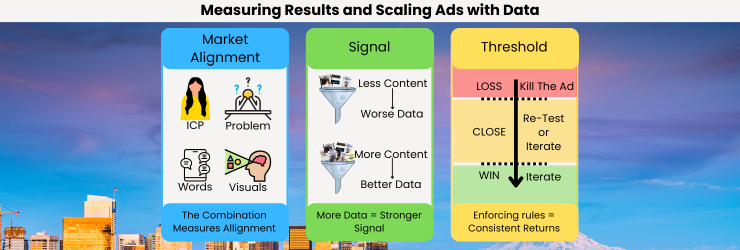
One of the most important implications of this mechanism is that creative testing volume and retargeting strategy are interconnected.
Top-of-funnel creatives introduce the problem or narrative to cold audiences. As those audiences interact with ads, retargeting layers move them down the awareness ladder:
Top-of-funnel creatives generate curiosity and problem recognition.
Mid-funnel retargeting introduces solution clarity and credibility.
Bottom-funnel retargeting removes remaining purchase objections.
This process resembles a controlled awareness progression rather than a single conversion attempt.
For example, if a top-of-funnel ad reaches a frequency of 3–4, the system has likely saturated the available audience segment with that message. At that point, introducing a middle-of-funnel retargeting creative continues the conversation rather than repeating the same message.
This approach increases the effective lifespan of each creative while generating additional conversion signals that inform future testing cycles.
In practical terms, advertisers who maintain structured creative testing pipelines typically identify scalable messaging angles after 10–30 creatives, though the exact number varies depending on hit rate and audience complexity.
This is also why Affilicademy offers 20 ads for free. It's enough for the average business to know exactly what will work for their ads.
This is important for getting predictable scaling outcomes from Meta ad creatives because high signal density enables the algorithm to identify profitable audience-message combinations.
Common Structural Mistakes and Misconceptions
Understanding the mechanism behind creative testing does not automatically prevent failure. In practice, most advertisers undermine their own campaigns through structural mistakes that distort performance signals.
These errors create the illusion that creative testing is unpredictable or inefficient when the real issue is flawed system design.
Mistake 1: Treating Creative Testing as Random Experimentation
One of the most common mistakes occurs when advertisers launch multiple creatives simultaneously without controlling variables.
They change headlines, offers, messaging angles, formats, and audience targeting within the same testing cycle. When results appear, it becomes impossible to determine which variable caused the performance difference.
This creates signal contamination.
The correct approach is controlled hypothesis testing. Each creative should represent a distinct messaging angle targeting the same core problem within the same ICP. By isolating variables, advertisers can attribute performance differences to message resonance rather than random variation.
Mistake 2: Scaling After a Single Winning Creative
Another structural error occurs when advertisers assume a single winning creative represents a scalable advertising strategy.
In reality, a single creative simply proves that one message resonates with one segment of the market.
Scaling requires creative redundancy.
If the entire campaign depends on one creative, performance will collapse as soon as frequency increases or audience saturation occurs. Sustainable scaling requires a portfolio of winning messaging angles, each capable of reaching different segments within the ICP.
Mistake 3: Ignoring Awareness Segmentation
Many advertisers run retargeting campaigns that simply repeat the same message shown in the original ad.
This ignores how buyer psychology evolves after initial exposure.
Cold audiences require problem recognition and curiosity.
Warm audiences require proof and credibility.
Hot audiences require risk removal and urgency.
We have a full article on levels of awareness here: https://affilicademy.com/post/advertising
When the same creative attempts to serve all awareness stages, conversion efficiency declines because the messaging fails to match the audience’s cognitive state.
A structured retargeting system progressively aligns messaging with awareness depth.
Mistake 4: Misinterpreting Frequency Signals
Frequency is often misunderstood in Meta advertising.
When a top-of-funnel ad reaches a frequency above 3 or 4, advertisers frequently assume the campaign is failing.
In reality, frequency often indicates message saturation, not audience exhaustion.
Instead of shutting off the campaign, operators should introduce mid-funnel retargeting creatives that continue the narrative. This preserves the signal generated by earlier engagement while advancing the prospect toward conversion.
Realistically a frequency of less than 10 means people might just barely remember your ads. Market saturation is not an issue, if conversions drop you need to reiterate your message with a new creative, problem, or offer.
Mistake 5: Underestimating Creative Production Capacity
A final structural error occurs when advertisers treat creative production as an occasional activity rather than a core operational function.
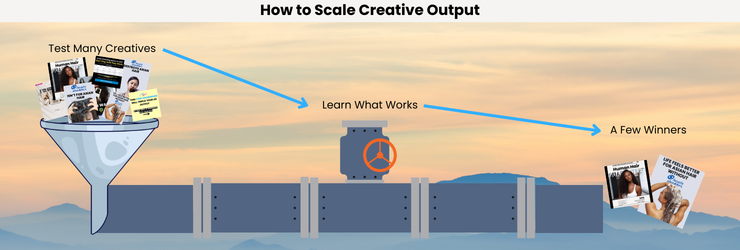
In scalable acquisition systems, creative output resembles a continuous pipeline rather than a periodic campaign launch.
Businesses that test only a few creatives each month inevitably encounter scaling limits because their signal generation rate cannot support higher spending levels. You legitimately want to test new creatives every week. Anywhere from 10-25% of your entire creative library can be changed consistently. (more for new accounts.)
This is important for getting accurate answers to how many ad creatives must be tested before scaling because structural mistakes distort the signals that reveal real message performance.
The Correct Strategic Framework
A scalable creative testing system requires a structured framework that aligns messaging, testing capacity, and iteration cycles. Within the Affilicademy methodology, this process resembles a controlled performance loop rather than a series of isolated campaigns.
The first component is precise ICP definition.

Creative testing becomes inefficient when messaging attempts to resonate with broad audiences. Instead, each campaign should focus on a narrowly defined customer profile with a clearly articulated problem.
This ensures that creative performance differences reflect messaging quality rather than audience mismatch.
The second component is awareness-stage alignment.
Each creative should correspond to a specific stage of buyer awareness:
Top-of-funnel creatives introduce the problem.
Middle-of-funnel creatives explain the solution and establish credibility.
Bottom-of-funnel creatives remove objections and reinforce urgency.
Retargeting ads are the mechanism that moves prospects between these stages.
When top-of-funnel frequency exceeds the 3–4 range, introducing middle-of-funnel retargeting creatives maintains engagement while progressing the narrative toward conversion.
This structure answers a common question: how to retarget Meta ads effectively. Retargeting is not simply showing the same ad again; it is delivering the next logical message in the awareness progression.
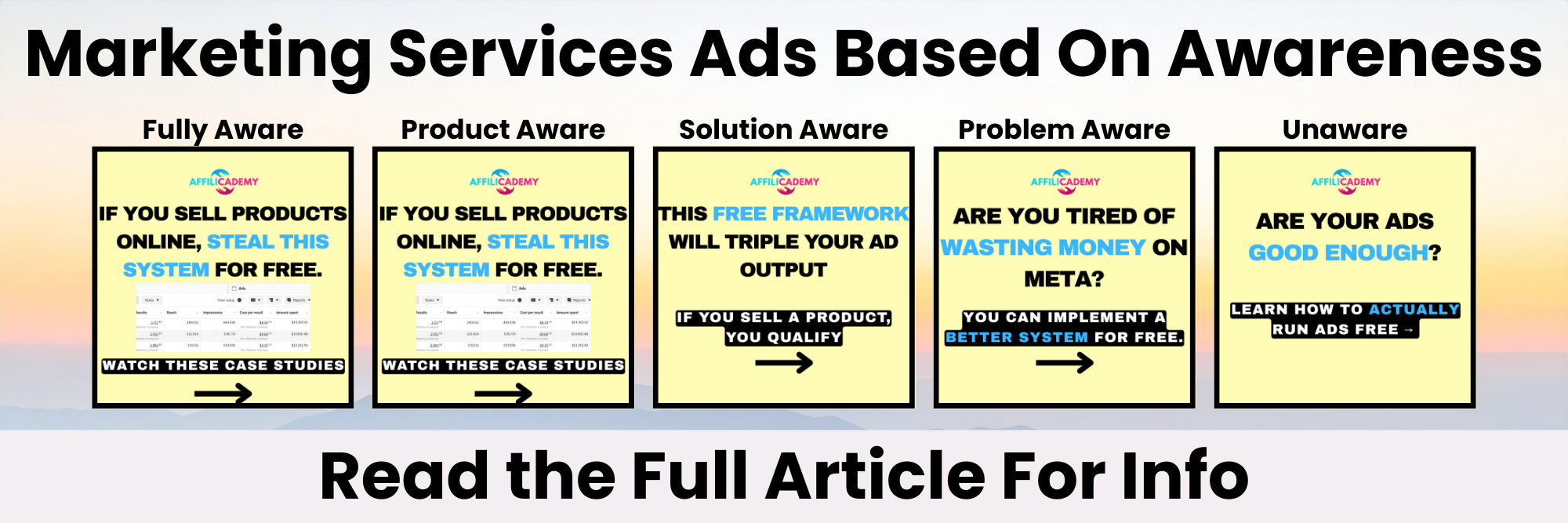
This is an example of different levels of awareness in an ad Affilicademy ran that got an average of 11% CTR, across all levels. This changes the game.
The third component is controlled creative testing matrices.
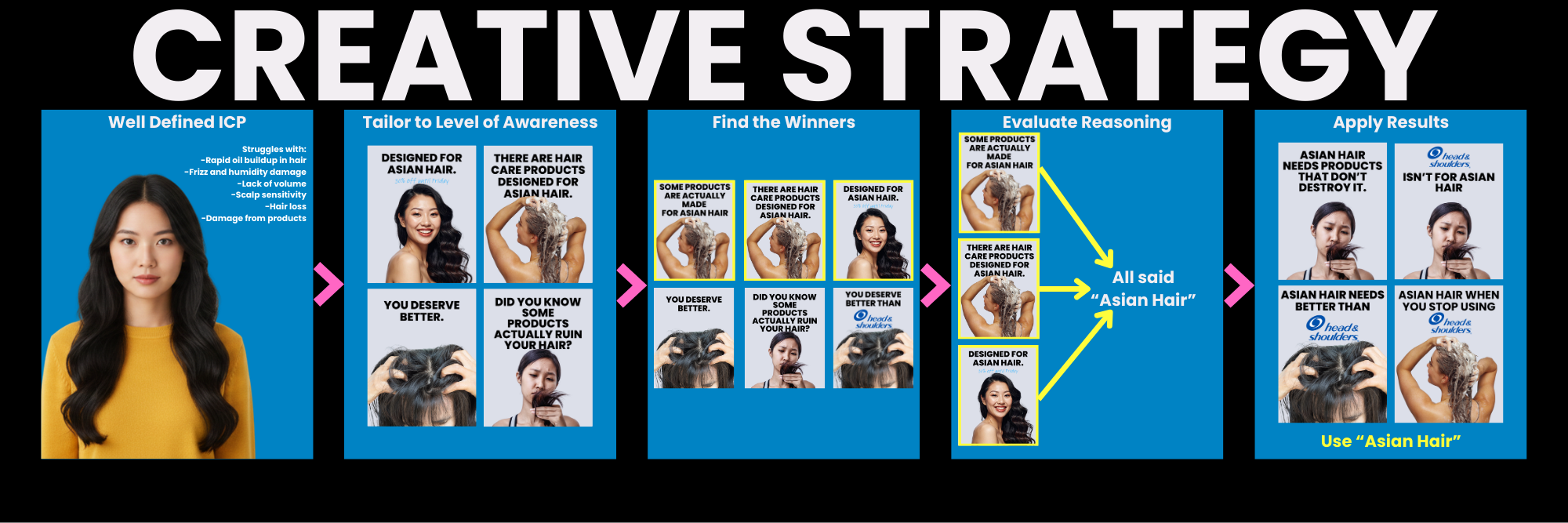
Each testing cycle should introduce multiple creatives representing different problem framings or narrative hooks while maintaining consistent targeting and offers. This isolates messaging as the primary variable.
This is a very small sample size example of this.
The fourth component is performance thresholds.
Before scaling any creative, operators should enforce minimum performance benchmarks such as:
Sustained click-through rates
Conversion hit rates
Cost per acquisition thresholds relative to target margin
Threshold enforcement prevents premature scaling based on incomplete signals.
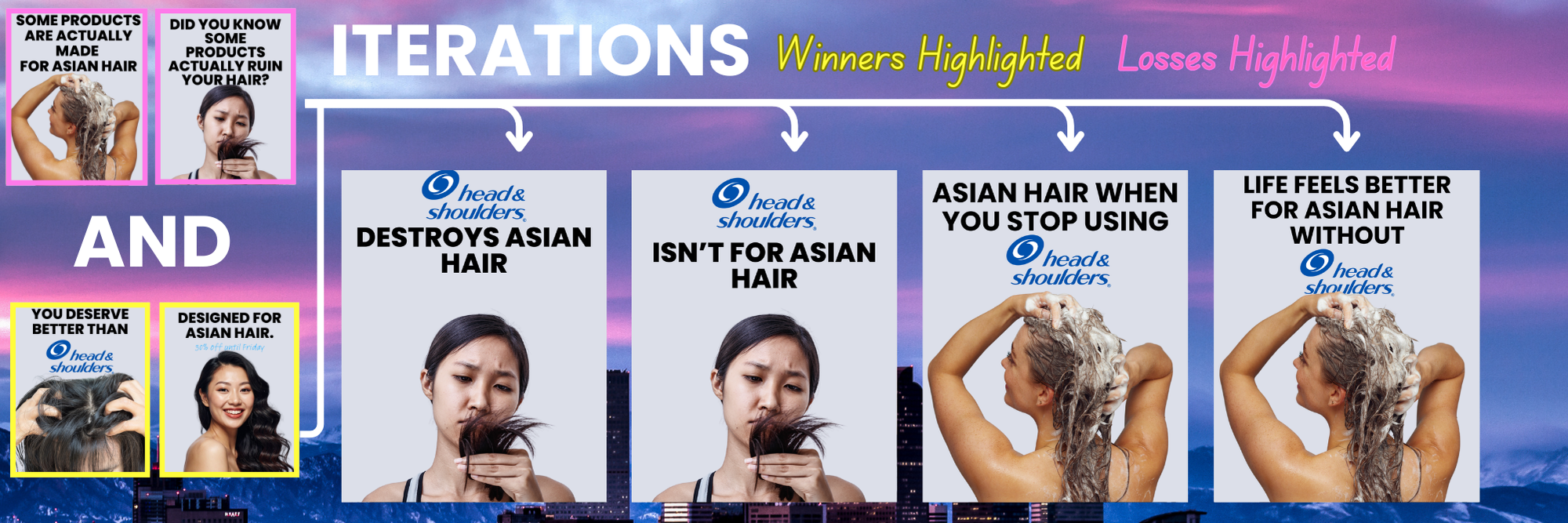
The fifth component is iteration cycles.
Creative testing should occur continuously, not sporadically. Each cycle generates new data that informs future messaging hypotheses.
Over time, this process produces a library of proven messaging angles capable of sustaining higher ad spend.
The sixth component is creative capacity scaling.
As ad budgets increase, the number of creatives entering the system must increase proportionally. This ensures that the system continues generating new signals faster than audiences become saturated.
This loop illustrates the fundamental economics of scalable advertising.
More creatives produce more signals.
More signals reveal more profitable messaging angles.
Profitable messaging increases margin.
Higher margin funds additional creative testing.
Over time, this cycle compounds into a robust acquisition engine capable of scaling predictably.
This is important for getting consistent answers to how many ad creatives must be tested before scaling because the framework converts creative testing into a structured signal-generation system.
Affilicademy Does the Best Meta Ads - And we Offer a Free Trial to Prove it.
This article showcases our advertising strategy very well. If you want it done for you, fill out the form on our website here.
FAQ
How many ad creatives do I need to test before scaling a product?
Most structured campaigns identify a scalable messaging angle after testing roughly 10–30 creatives. The exact number depends on hit rate and market complexity, but disciplined testing dramatically reduces the amount of guesswork required.
How many ad creatives do you test each month?
High-performing acquisition teams often test 50-100+ new creatives per month. This volume maintains signal density within the ad account and prevents creative fatigue from limiting scaling.
What’s the best way to test and scale Meta ads creatives right now?
Use controlled creative testing where each ad represents a distinct messaging hypothesis targeting the same ICP. Once a creative meets defined performance thresholds, increase spend gradually while continuing to introduce new creatives into the testing pipeline.
How do Facebook retargeting ads help scaling?
Retargeting ads increase conversion efficiency by delivering stage-specific messaging to users who have already interacted with top-of-funnel creatives. This allows campaigns to maintain performance even as frequency increases.
How should I structure retargeting with Andromeda-style Meta campaigns?
Retargeting should follow the awareness progression: top-of-funnel ads generate curiosity, mid-funnel ads introduce proof and explanation, and bottom-funnel ads remove objections. Each stage advances prospects toward conversion rather than repeating the same message.
What frequency should trigger retargeting creatives?
When top-of-funnel ads reach a frequency around 3–4, it often indicates message saturation. Introducing middle-of-funnel retargeting creatives at that point maintains engagement and improves conversion rates.