
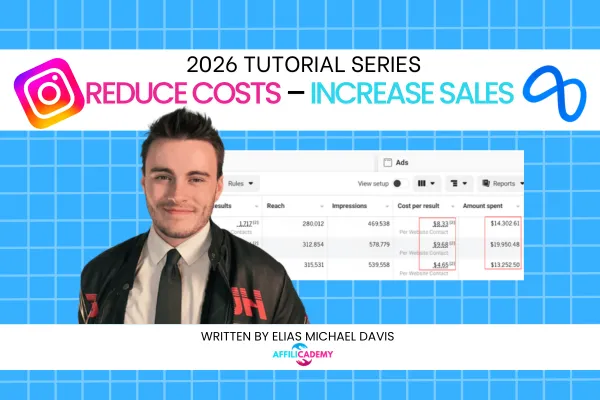
Reducing Total Ad Cost While Increasing Conversions in 2026 on Meta
How Do I Reduce Ad Spend on Meta for the Same Conversions?
Key Takeaways
Reducing ad spend while maintaining conversions is primarily a CPA problem, not a budget problem.
When advertisers ask how to reduce ad spend on Meta, they are usually trying to reduce the cost per acquisition (CPA). Lower CPA allows the same conversion volume to be produced with less total spend. I.E. your cost would go down from $500 for 10 conversions down to $250 for 10 conversions.
Creative testing volume is the primary driver of lower CPA.
The more structured creative tests you run, the faster you discover high-converting messages. These winning creatives increase click-through rate, reduce CPC, and ultimately reduce CPA.
Ad efficiency improves through systematic iteration, not optimization tweaks.
Operators who lower CPA consistently do so through controlled testing cycles where poor creatives are replaced and high performers receive increased spend.
Scaling profitably requires enforcing performance thresholds.
Ads that fail to meet conversion benchmarks must be removed from spend allocation. Budget concentration on validated ads is what lowers blended CPA.
Skip to How to Fix the Ads
Common Structural Mistakes and Misconceptions
Mistake 1: Random Creative Experimentation
Mistake 2: Treating CPC or CPM as the Primary Optimization Metric
Mistake 3: Insufficient Creative Testing Capacity
How to Fix Your Advertising Results
Step 1: Identify When Creative Fatigue Is Beginning
Step 2: Introduce New Message Angles
Step 3: Run Structured Creative Testing
Step 4: Enforce Performance Thresholds
Step 5: Replace Fatigued Creatives Before Performance Declines
Step 6: Reinvest Efficiency Gains Into More Testing
How do I reduce ad spend and increase conversions?
How do I increase ad efficiency on Meta?
Introduction
Advertisers trying to reduce ad spend on Meta while maintaining the same conversions usually focus on targeting, bidding, or campaign settings.
This is the wrong way to do it. Meta performance is primarily driven by message performance, not campaign configuration. In campaigns where you simply focus all effort into the creative, you will outperform a bad creative in a great setup. This is because Meta is rewarded with audience retention if your ad is interesting.
Every ad is a message experiment. Some messages resonate and generate strong engagement, while others do not. Without structured testing, advertisers cannot identify the messages that produce disproportionate performance.
Therefore, the way to reduce your CPA (costs) is simply to test more creatives, and improve in cycles. This article is written to allow you to do that efficiently.
Common Structural Mistakes and Misconceptions
Mistake 1: Random Creative Experimentation
Many advertisers run creative tests without controlled variables. They change hooks, visuals, audiences, landing pages, and offers simultaneously.
This creates performance noise. When results improve or decline, there is no way to determine which variable caused the change.
Without controlled testing, advertisers cannot isolate the messages responsible for high conversion rates.
The correct structural approach is controlled experimentation. Each creative test should isolate one core variable, usually the messaging angle or hook. This allows performance improvements to be attributed to specific messages.
Mistake 2: Treating CPC or CPM as the Primary Optimization Metric
Advertisers often attempt to reduce CPC or CPM through targeting or placement adjustments. This approach misunderstands how the auction works.
Lower CPC is not something that can be directly optimized. It is an outcome produced by stronger engagement signals.
When creatives generate higher click-through rates, the platform rewards them with cheaper distribution.
Therefore the correct optimization lever is creative resonance, not bid manipulation.
Mistake 3: Insufficient Creative Testing Capacity
Many advertisers run between 3-5 ads at a time. This severely limits their probability of discovering high-performing messages.
Creative performance follows a hit-rate distribution. Only a small percentage of ads will significantly outperform the average. (usually 10% - 30%)
Without sufficient testing volume, advertisers rarely discover these outliers.
Increasing creative testing capacity dramatically increases the probability of finding ads that reduce CPA.
How to Fix Your Advertising Results
Step 1: Identify When Creative Fatigue Is Beginning
Before performance collapses, early warning signals appear in the account.
The most common indicators are declining click-through rate, rising CPC, and increasing frequency without corresponding improvements in conversion volume.
These signals indicate that the audience is becoming saturated with the current creative set.
At this stage, most advertisers attempt tactical adjustments such as audience changes or budget shifts. These actions rarely solve the problem because they do not address the underlying issue: creative exhaustion.
The correct response is to introduce new messaging variations before fatigue fully impacts performance.
Step 2: Introduce New Message Angles
Creative iteration should focus on message variation, not superficial design changes.
Changing colors, editing captions, or altering minor visual elements rarely produces meaningful performance improvements. What matters is whether the ad communicates a different problem, insight, or narrative to the audience.
Each new creative should therefore test a distinct message type.
Examples include curiosity-driven hooks, problem-solution narratives, statistical insights, social proof, or contrarian “us vs. them” positioning.
This process expands the account’s message discovery capacity, allowing the market to reveal which narratives resonate most strongly with the target audience.
Step 3: Run Structured Creative Testing
Rather than replacing ads randomly, new creatives should be introduced through controlled testing.
Multiple creatives should run simultaneously so performance comparisons can be made under similar delivery conditions.
The objective is not to guess which creative will succeed. The objective is to generate sufficient testing volume so that performance data reveals the strongest messaging.
Accounts that test consistently uncover new winning creatives before older ads lose effectiveness.
Step 4: Enforce Performance Thresholds
Testing only improves performance if weak creatives are removed quickly.
Ads that fail to meet defined engagement or conversion benchmarks should be paused so budget can be concentrated on higher-performing creatives.
This step is critical because Meta’s auction rewards ads that generate strong engagement signals. When spend is concentrated on these creatives, CPC declines and conversion efficiency improves.
Without strict threshold enforcement, budget becomes diluted across underperforming ads and overall account performance stagnates.
Step 5: Replace Fatigued Creatives Before Performance Declines
Winning creatives eventually experience diminishing returns as audiences become familiar with them.
Advertisers who rely on a small number of ads are forced to react after performance deteriorates.
Structured advertisers operate differently.
Because they are continuously testing new creatives, they already have replacement ads ready when performance begins to weaken. This allows them to maintain performance stability as spend increases.
Accounts without creative iteration experience a steep CPA increase as spend grows.
Accounts with ongoing creative testing maintain relatively stable CPA because new winning creatives replace fatigued ones before engagement declines.
Step 6: Reinvest Efficiency Gains Into More Testing
When stronger creatives reduce CPA, profit margins expand.
Instead of simply withdrawing this efficiency as savings, disciplined advertisers reinvest a portion of the gains into additional creative testing.
This produces a compounding improvement loop.
Each testing cycle increases the probability of discovering stronger messaging. Stronger messaging improves engagement signals, reduces auction costs, and allows the account to generate the same conversions with less advertising spend.
Over time, the system continuously improves the account’s acquisition efficiency.
If you Want Personalized, Performance Based Help
I offer performance based ads to businesses who have some previous sales but want to grow or haven't cracked meta yet. You'll only pay if I drive meaningful profit to your business. Check it out with the link here:
https://affilicademy.com/10freeugc

FAQ
How do I reduce ad spend and increase conversions?
Focus on lowering CPA rather than lowering budget. Increase creative testing volume to discover high-converting messages, then shift spend toward those ads while eliminating underperformers.
How do I increase ad efficiency on Meta?
Ad efficiency improves when your creative generates stronger engagement signals. Test multiple messaging angles, identify which ads produce the highest click-through and conversion rates, and concentrate spend on those creatives.
How do I maximize conversions on Meta ads?
Run structured creative tests targeting one core problem per campaign. This improves message relevance, which increases click-through rates and conversion probability.
How do I reduce CPA on Meta?
Increase creative iteration and enforce performance thresholds. Pause ads that miss CPA targets and allocate spend only to validated high-performing creatives.
How do I reduce CPC or CPM on Meta?
Lower CPC and CPM are typically the result of stronger engagement signals. Ads with higher click-through rates receive cheaper distribution in the auction system.