How to Retarget Audiences Using Video Ads in 2026
Most retargeting campaigns fail before the first ad is ever written.
I know that sounds backwards. You'd assume the problem is creative - wrong hook, bad offer, weak call to action. That's what I thought for a long time. Then I ran a campaign where everything looked right on paper: solid product, clean video, tight copy. It barely moved the needle. The issue wasn't the ad. The issue was that I'd aimed it at people who had no real knowledge of my brand and called them a "retargeting audience." They weren't. I was paying retargeting prices for cold traffic results.
Before I Continue, the Video Version:
This article has a video version filmed by me, overviewing the same strategies outlined in this article. Check it out!
Step 1 - Building the Funnel
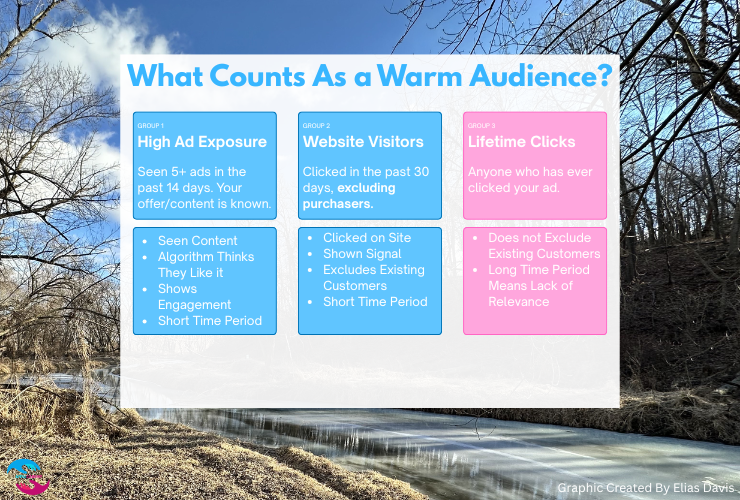
The first step to a retargeting funnel that actually works is building the right audience in the first place. There are two groups worth targeting. The first is people who have seen five or more of your ads in the past fourteen days. There are people who have been exposed to your brand repeatedly, which means something about your offer is already registering. The second group is people who have visited your website, within the last month, with purchasers excluded. These people went far enough to click, which is a meaningful signal.
What most advertisers do instead is retarget anyone who clicked anything, once, ever. When you start from a weak audience definition, you are fighting uphill to get the same results.
The Simple Version: Hit Them With Product-Aware Ads
Once your audience is defined properly, step two is surprisingly simple. You're not trying to educate these people from scratch. They've already seen you. They know roughly what you do. What they need is a reason to act now.
Run product-aware ads. These are direct, conversion-oriented creatives that show the product, explain the value clearly, and ask for the purchase. Keep the budget modest and watch frequency at the ad set level. For website visitors, you want to hit somewhere around three times in the viewing window. At this stage, you're just making sure the decision they were already close to making gets finished.
This is where most advertisers stop, and for many offers, it's enough. But if you want to build something that compounds over time, something that brings in people who are almost ready, not just people who are already there, there's a third layer that massively improves long term results.
The Full Funnel: Meet People Where They Actually Are
I started building awareness-first retargeting structures after noticing a pattern across several campaigns. The conversions were coming, but the audiences were burning out fast. After three or four weeks, performance would drop because I'd saturated the warm pool. There wasn't enough volume coming in at the top to replenish it.
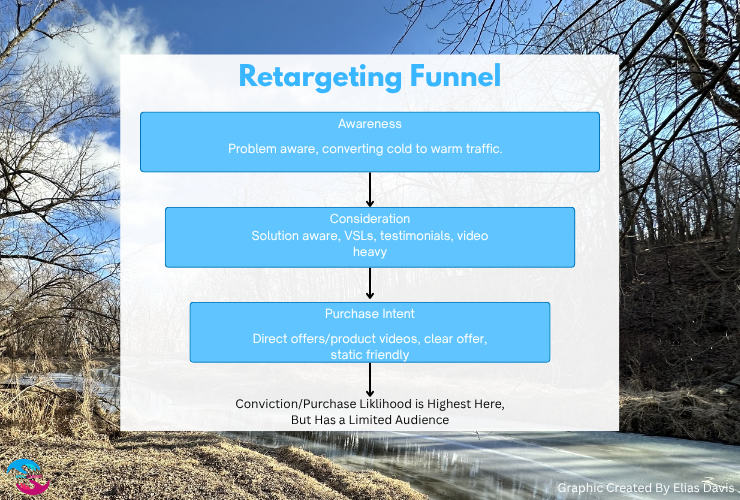
The solution was to go earlier in the decision process. Instead of only running product ads to people already familiar with the offer, I added a layer of problem-aware and solution-aware content. Short videos that named the problem clearly, longer pieces that walked through why the solution mattered, landing pages with video sales letters and testimonials. The point wasn't to sell immediately. It was to move people forward in their thinking, then retarget them with purchase intent ads once they'd consumed that content.
What this does mechanically is increase the total audience in warmer segments. Instead of drawing from one fixed pool of warm visitors, you're continuously producing new warm visitors out of a colder audience by giving them genuinely useful content first. The purchase intent ad at the end lands harder because the person receiving it has already gone through your funnel mentally.
Static vs. Video in a Retargeting Funnel
The question of static versus video comes up constantly in retargeting conversations, and the answer depends on where in the funnel you are. Video earns its budget at the awareness and consideration stages, problem-aware content, solution walkthroughs, testimonials. These formats need motion and voice to hold attention long enough to build the kind of understanding that moves someone forward. A static image can't do the same work.
Lower in the funnel, static ads are often more efficient. By the time someone is ready to buy, they don't need another two-minute walkthrough. They need a clean product image, a clear offer, and a direct path to checkout. Static is faster to produce, cheaper to run at scale, and performs well when the audience already has context. The mistake is using video everywhere because it feels more premium or using static everywhere because it's easier to make. Format should follow function.
A note here. Videos, when produced well, will still outperform image content even at higher levels of awareness. The big question is if the budget cost of producing said videos will pay for itself based on how large of an audience you have.
The Common Mistake That Destroys Retargeting Budgets
The most expensive error in retargeting is confusing activity with intent. Someone who clicked on an ad six weeks ago and never came back is not a warm lead. Running purchase-intent creatives at them is wasted spend. Your retargeting audience definitions need time boundaries, and they need to be rebuilt around meaningful behaviors, sustained ad exposure, actual site visits, content consumption, not just any click that ever registered in the pixel.
The second mistake is running retargeting in isolation from prospecting. If your top-of-funnel volume drops, fewer new people seeing your ads, fewer website visitors, your retargeting pool shrinks. Retargeting looks like it's underperforming when the real problem is that there aren't enough people. These two things feed each other. Treat them as a system, not separate campaigns.
A second note. You can tell if the retargeting pool is shrinking by looking at frequency. As the frequency increases, it tells you that people are re-viewing the same ad many times. This usually means you need a bigger audience or new creatives, or both.
The Strategic Takeaway
A retargeting funnel in 2026 isn't a single ad set aimed at past visitors. It's a sequence built around how people actually make decisions, first awareness, then consideration, then purchase intent, with each layer feeding the next. Build the right audience, give them content that moves them forward, then close with direct ads aimed at people who are genuinely ready. That structure doesn't just convert better. It scales better, because it doesn't depend on a fixed pool of warm traffic to survive.
Free Trial of Meta Ads
If you are tired of high costs, a free trial is probably just what you need. I will run all of your ads, and then, once you get great results, we switch to a performance basis. Split the sales. 0 cost up front.
Learn more here: https://affilicademy.com/10freeugc
FAQ
What's the best retargeting funnel structure for Meta ads?
The most effective structure works in three layers: first, you define a high-quality audience using people who have seen five or more of your ads in the past fourteen days or who have visited your website excluding purchasers. Second, you run product-aware ads to that audience with controlled frequency. Third, if you want a compounding system, you add problem-aware and solution-aware content earlier in the funnel so new people are continuously being moved into the warm pool.
How do video ads perform differently than static ads in retargeting?
Video earns its keep at the top and middle of the funnel, where the goal is building understanding — explaining a problem, walking through a solution, or letting a real customer testimonial do the convincing. Static ads tend to outperform video at the bottom of the funnel, where the audience already has context and just needs a clear product image and a direct offer. Matching format to funnel stage matters more than defaulting to one format across the board.
What frequency should I target for website visitor retargeting?
For website visitors, aim for around three impressions per person within your retargeting window at the ad set level. This is enough to remind someone who showed genuine intent without crossing into the territory where frequency starts working against you by building annoyance rather than familiarity. If frequency climbs significantly above that, consider whether your audience pool is too small or your window is too long.
Why isn't my Meta ads retargeting converting even with good creative?
The most common cause is a weak audience definition. If you're retargeting anyone who clicked anything at any point, you're treating cold traffic as warm. Check your audience parameters first — make sure you're working with people who have had meaningful recent exposure to your brand. The second most common cause is a mismatch between creative and funnel stage: running a direct purchase-intent ad to someone who's only seen you once rarely works.
How does video view retargeting work as a cold-to-warm bridge?
When someone watches a meaningful portion of one of your video ads — typically fifty percent or more — that signals genuine interest even if they never clicked. You can build a custom audience from these viewers and move them into a retargeting sequence. This is a way to generate warm audience volume without depending entirely on website traffic, which is valuable when your site visitor pool is too small to support consistent retargeting spend.
What's the difference between a product-aware ad and a purchase intent ad?
A product-aware ad assumes the viewer knows a problem exists and shows them your solution clearly — it's informational and direct. A purchase intent ad assumes the viewer already understands the solution and is deciding whether to buy yours — it's designed to remove friction, create urgency, and drive the final conversion action. Both have a place in a retargeting funnel, but they serve different audiences at different stages of the decision process.
Glossary
Awareness stage:
The phase in a buyer's journey where the person recognizes they have a problem but has not yet identified a specific solution. Advertising at this stage is focused on naming the problem in a way that resonates, not on selling a product directly.
Custom audience:
An ad targeting segment built from first-party data such as website visitors, video viewers, or email lists, rather than interest or demographic filters. Custom audiences are the foundation of effective retargeting.
Frequency:
The average number of times a single person in your audience sees your ad over a given time window. In retargeting, frequency is a key variable — too low and the ad doesn't register, too high and it creates negative associations.
Funnel stage:
A classification of where a potential customer sits in their decision-making process, typically divided into awareness, consideration, and conversion. Matching creative and messaging to the correct funnel stage is central to retargeting strategy.
Meta ads retargeting:
The practice of serving ads on Facebook and Instagram specifically to people who have already had prior contact with your brand, such as visiting your website, viewing your content, or engaging with previous ads.
Problem-aware audience:
A segment of potential buyers who understand they have a problem but have not yet been exposed to your specific solution. Content aimed at this group focuses on the problem itself before introducing your product.
Product-aware ad:
A creative format designed for audiences who already understand the solution category and are evaluating specific products. These ads lead with product features, proof, and direct offers rather than problem framing.
Purchase intent ad:
A direct-response creative designed to convert someone who is already close to a buying decision. These ads typically include a clear offer, urgency mechanism, and a friction-reduced path to checkout.
Retargeting window:
The time period over which past visitor or viewer behavior is tracked to define a retargeting audience. A fourteen-day window captures recent, high-intent behavior; longer windows include colder, less relevant contacts.
Solution-aware audience:
A segment that understands both the problem they have and the general category of solution available, but has not yet decided on a specific product or provider. Advertising to this group focuses on differentiation and trust-building.
Video sales letter (VSL):
A long-form video format used on landing pages or in ads that walks a viewer through a structured persuasion sequence — typically covering the problem, the solution, credibility signals, and a call to action — in a single continuous presentation.
Website visitor audience:
A custom audience built from people who have visited one or more pages of your website within a defined time window, typically tracked through a Meta pixel. Excluding purchasers from this audience is standard practice to avoid wasting spend on people who have already converted.