
Why You Should Never Use Target Market - Use ICP Instead
Why Is Single-ICP Targeting More Effective Than Broad Targeting? (Target Market)
Key Takeaways
Single-ICP targeting increases message precision.
When every advertisement is built around one clearly defined ideal customer profile (ICP), the messaging becomes highly specific, which dramatically improves resonance and conversion rates.
Broad targeting makes it harder to both write and understand messaging.
Campaigns aimed at vague audiences produce mixed behavioral feedback, making it difficult for advertising platforms to optimize delivery efficiently.
High-performing advertising systems rely on testing and iteration.
When a campaign speaks to one ICP, engagement, click-through rates, and conversions cluster around the same behavioral patterns, producing clearer optimization signals. This makes growth simpler.
There are often thousands of buyers identical to the ICP.
Even though campaigns focus on a single ideal profile, real markets contain large clusters of individuals with nearly identical problems and motivations, allowing scale without sacrificing precision.
Performance stability comes from consistent messaging and response.
Single-ICP targeting works because it aligns audience, message, creative, and offer into one coherent system rather than forcing one campaign to appeal to multiple buyer types.
Core Idea
Most advertisers treat targeting as a simple platform setting. They expand demographics, stack interests, and attempt to reach the largest possible audience under the assumption that more reach creates more conversions.
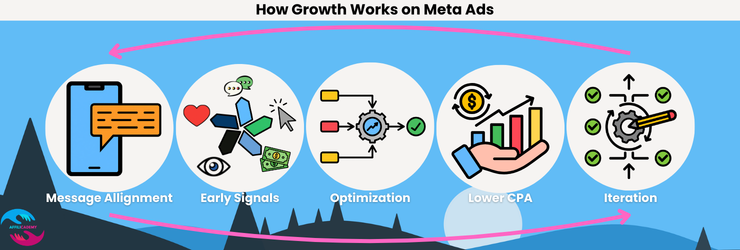
The reality for most businesses (I’ll exclude Coca Cola and Amazon from this list) is that if you try to advertise to everyone, you are effectively advertising for nothing. Andromeda, through the Instagram and Facebook platforms, optimize for behavior. For example, someone clicking your ad.
When someone clicks you ad, Meta knows it is a good ad, and aligned with that audience. They decrease the CPM and your CTR increases. Meta shows it to similar audiences. Repeat.
If you have an ad few people click because it doesn’t have strong enough motivation for anyone (an example of this would be “free roof installs” vs “free roof installs if you were victim to {recent tragedy}.” Even though the offer is the same, the targeting actually increases peoples likelihood of response because it feels more special.
And never forget, even though ICP feels like you are only talking to one person, there are thousands who are likely the exact same or so similar you can’t tell the difference.
The reason this works so well is because campaigns targeting a single ICP create a clear signal for the platform to optimize. When your messaging speaks directly to one buyer’s specific problem, engagement is higher.
Those clicks, likes, and conversions tell the algorithm, “this ad resonates with this type of person.” Meta then finds more users who behave the same way, lowering CPMs and boosting conversions. Broad targeting makes this process fail, since the person in the "target market" may be barely aligned with your message.
signals get messy because some people click but don’t convert, others convert with low engagement, and many ignore it entirely. Single-ICP targeting prevents this, giving the platform consistent, high-quality data and predictable performance.
This effectively answered “Why is single-ICP targeting more effective than broad targeting?” Now we go on to implementation.
Step By Step Implementation of ICP vs Target Market (Advanced Targeting Frameworks)
If you want to make ICP targeting work for your business, each step in this process needs to optimize for Meta's Andromeda algorithm. The goal should be to talk to as specific of a person that you can, and iterate on the top message types.
Step 1: Define the Ideal Customer Profile
Start by identifying the individual who experiences the problem most intensely and benefits most clearly from the product. A strong ICP describes the buyer’s current situation, their core frustration, and the outcome they want to achieve. Specifically, it tends to be the easiest to list out the problems that you are able to solve, ordered by most to least impactful
(I.E. if you can solve cancer that's more important than changing the color of their pencil from slate grey to dark grey.)
Step 2: Design Campaigns Around One Core Problem
Each campaign should address a single problem experienced by the ICP. Headlines, visuals, and offer positioning should all revolve around this issue, ensuring the message immediately resonates with the intended buyer.
Step 3: Run Controlled Creative Tests
Rather than testing random ad variations, evaluate different hooks, angles, and formats while keeping the same ICP. This isolates which creative approaches generate the strongest engagement signals.
Step 4: Optimize Using Engagement Signals
Monitor metrics such as click-through rate, conversion rate, and cost per acquisition to identify which ads resonate most with the ICP. Prioritizing high-performing creatives strengthens the platform’s optimization signals.
Step 5: Expand The Number of Creatives With the Budget as You Scale
As budgets increase, introduce new creative variations to maintain engagement and prevent fatigue. Scaling requires creative volume to sustain strong signals across larger audiences.
Implementation Options

Single-ICP targeting outperforms broad targeting because focused messaging produces clearer signals, better optimization, and scalable performance.
If you want me to implement this, for free, than fill out the form below. After it works, I can work with you long term on a performance basis. (I profit when you do.)
https://affilicademy.com/10freeugc
FAQ
What is an ICP in marketing?
An ICP (Ideal Customer Profile) is a detailed representation of the customer who gains the most value from a product and is most likely to convert. It focuses on the specific problem the buyer faces, their motivations, and their purchasing triggers.
What is the difference between a target audience and an ICP?
A target audience is a broad group defined by demographics or interests, while an ICP represents one precise type of buyer. Advertising built around an ICP produces more focused messaging and stronger conversion signals.
Is targeting a single market more effective for strong brand loyalty?
Yes. When messaging consistently addresses the specific problems of one audience, it creates deeper relevance and trust, which strengthens brand loyalty and repeat purchasing behavior.
What are the four targeting strategies commonly used in marketing?
The most common approaches include demographic targeting, interest-based targeting, behavioral targeting, and ICP-driven targeting. ICP targeting typically produces the strongest results because it aligns messaging directly with the buyer’s core problem.
What does an ideal customer profile template include?
A strong ICP template includes the customer’s role or situation, their primary problem, the consequences of that problem, their desired outcome, and the triggers that cause them to seek a solution. This information allows advertisers to craft precise, high-converting messaging.