
The Key to Profitable Meta Ads at Scale is Understanding This One Thing.
Key Takeaways
Increasing an ad budget is not the same as scaling ads.
Increasing budgets simply pushes more money into the same system. Scaling requires maintaining performance as volume increases, which demands stronger infrastructure across creative production, audience reach, and operational capacity.Scaling exposes weaknesses that small budgets hide.
Campaigns that perform well at low spend often fail when budgets increase because flaws in creative, targeting, or fulfillment systems become amplified.Creative capacity is the primary constraint in most scaling attempts.
As ad spend increases, the volume of impressions rises rapidly. Without new creative entering the system at the same pace, frequency increases and performance deteriorates.
If you Prefer Video,
I filmed this just for you. It has the same information from this article, in a way that is easy to consume.
There is a glossary at the end of this article. I encourage you to check it for any niche-specific words that are unfamiliar.
Table of Contents
The Fundamental Difference Between Increasing Budgets and Scaling Ads
The Awareness Principle Behind Profitable Advertising
Creative Supply: The Real Scaling Constraint
Operational Capacity: When Ads Outgrow the Business
Introduction
Many advertisers believe scaling ads is simple.
If a campaign works at $50 per day, the logical next step is increasing the budget to $200, then $500, then $1,000.
This doesn't work unless you take steps to scale everything around the budget.
Performance declines, CPA rises, and advertisers conclude the platform algorithm has stopped working.
Scaling ads means increasing spend while maintaining performance efficiency.
This distinction matters because advertising performance depends on several underlying systems: message alignment, audience reach, creative supply, algorithmic learning, and operational capacity.
When those systems remain static while budgets increase, campaigns become unstable.
Understanding the difference between these two concepts is essential for building advertising systems that can grow predictably.
The Fundamental Difference Between Increasing Budgets and Scaling Ads
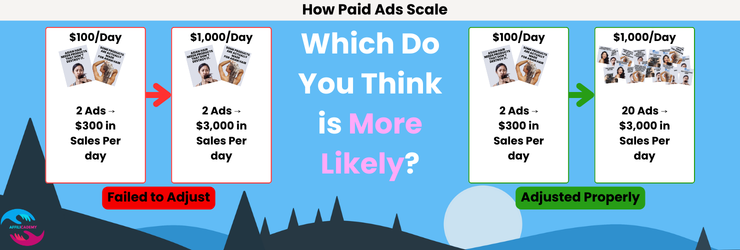
Increasing a budget is an instruction.
Scaling is a result.
When advertisers increase campaign budgets, they instruct the platform to enter more auctions and deliver more impressions.
However, this change does not guarantee the campaign can maintain the same cost per acquisition.
In fact, budget increases introduce several structural pressures.
First, the platform must find additional users to deliver impressions to.
Second, campaigns begin reaching deeper segments of the audience, to lower levels of awareness, where conversion probability is lower.
Third, higher impression volume increases exposure frequency, which accelerates creative fatigue.
Because of these dynamics, scaling ads is defined by maintaining efficiency while volume increases, not by the amount of money spent.
A campaign that increases spending from $500 to $3,000 per day while maintaining similar CPA has successfully scaled.
A campaign that increases spending but doubles its CPA has simply increased costs.
The Awareness Principle Behind Profitable Advertising
Surprisingly, on Meta ads, one of the most ignored metrics is audience awareness.
Every market contains audiences at different stages of understanding.
Some people are unaware they have a problem.
Others recognize the problem but have not considered solutions.
Some are evaluating solutions, while others are already familiar with specific products.
Effective advertising aligns messaging with these awareness stages.
The typical awareness progression looks like this:
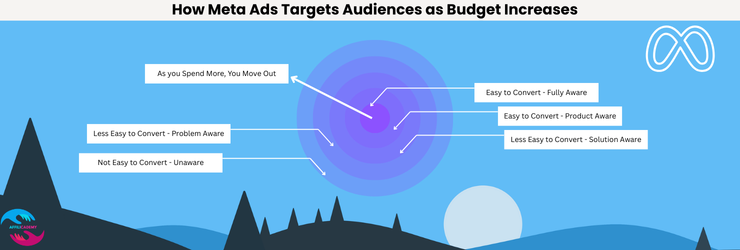
Unaware audiences do not recognize the problem. Advertising must educate the problem itself.
Problem-aware audiences understand the issue but do not know solutions exist. Ads must introduce the category of solution.
Solution-aware audiences know solutions exist but are comparing options. Messaging should differentiate the benefits of going with a specific brand.
Product-aware audiences already know your product. Ads must provide credibility and proof, and a reason to purchase now.
Most-aware audiences only need a reason to act. Messaging focuses on urgency or offer structure.
When budgets increase, platforms expand delivery into colder audiences.
If messaging remains optimized for product-aware audiences, but the campaign begins reaching problem-aware audiences, conversion rates decline.
This is why increasing budgets often causes CPAs to rise.
The messaging no longer matches the awareness level of the audience being reached.
Creative Supply: The Real Scaling Constraint
The most common bottleneck in advertising systems is creative supply.
As budgets increase, impression volume rises rapidly.
If the number of active ads remains constant, the same creative is shown repeatedly to the same audience.
This causes frequency to rise.
High frequency leads to declining engagement and increased CPMs.
Eventually the platform interprets declining engagement as poor ad quality and reduces delivery efficiency.
Successful advertisers solve this problem by maintaining a consistent ratio between spend and creative volume.
As budgets increase, new creative must enter the system continuously.
When you do this at the most advanced level, you tailor groups of retargeting ads up the levels of awareness, introducing batches of creatives that target specific audiences. You adjust budget accordingly.
We have a full article on that subject here: https://affilicademy.com/post/retargeting-ads
Operational Capacity: When Ads Outgrow the Business
A clear example of this came from scaling my own business, Affilicademy.
When I first started running ads, I was usually spending somewhere between $50 and $100 per day. The exact number depended on how the previous month had performed and how comfortable I felt increasing spend. At that level, the system worked well. I was generating around two to three qualified leads per day, and I personally handled everything in the business.
I was doing the sales calls.
I was designing the ad strategies.
I was onboarding clients.
I was fulfilling the work.
Because the volume was small, this structure worked perfectly. Every lead could receive personal attention, and the operational workload stayed manageable.
As results improved, I began increasing ad spend gradually. Instead of jumping budgets dramatically, I increased them by about $100 per day each week. Eventually I reached roughly $400 per day in spend.
At that point, the acquisition system was producing close to 100 qualified leads per week.
The ads were working.
But my business wasn’t built to handle that level of demand yet.
The first real bottleneck appeared in fulfillment. Designing effective advertising strategies for new businesses takes time. Each client required analysis, planning, and creative direction. When the volume of new clients increased, it became impossible for me to maintain the same level of quality on my own.
So instead of continuing to scale ads, I actually turned them off entirely.
For nearly two months, I paused advertising so I could focus on building the infrastructure the business needed to support growth.
During that time I implemented systems using a CRM. I built automation flows for lead routing, onboarding sequences, email communication, and client management so the process would not depend entirely on manual work.
At the same time, I started building a team.
I brought in someone to manage creators and coordinate affiliate content.
I hired a graphic designer to produce image-based ads.
I added an editor to support video content.
And I brought in a salesperson to handle inbound leads.
This shifted the business from a one-person operation into a structured system.
The advertising system also had to evolve.
Early on, my ratio of creatives to ad spend was relatively low. I was probably introducing one new creative for every $10–$12 in daily ad spend.
As budgets increased, that ratio became a problem. Impression volume was rising faster than creative supply, which meant the same ads were being shown repeatedly.
To solve this, I increased creative testing capacity significantly.
Today my system runs closer to a 5:1 ratio, meaning for roughly every $5 per day in ad spend, I introduce one new creative into testing. This ensures that as impressions grow, new ads are constantly entering the system and preventing creative fatigue.
The experience made one thing very clear to me.
Scaling ads does not just mean increasing budgets.
When I increase ad spend, I also need to increase creative production, operational capacity, and fulfillment capability at the same time.
This is why scaling ads is never just a budgeting decision. It’s a system design decision for the entire business.
A Strategic Framework for Scaling Ads
Scaling ads successfully requires expanding several systems simultaneously.
First, messaging must align with audience awareness levels.
As budgets increase and audiences broaden, campaigns must introduce creative designed for colder segments.
Second, creative production must expand.
Advertisers must continuously test new ad variations to prevent fatigue and maintain engagement.
Third, audience reach must expand.
This may involve broader targeting, new platforms, or additional acquisition channels.
Fourth, operational systems must scale.
Sales teams, automation workflows, and fulfillment capacity must grow alongside advertising demand.
Scaling therefore requires designing a system where these components expand together.
Budgets alone cannot produce scalable growth.
Conclusion
The difference between increasing budgets and scaling ads is structural.
Increasing budgets simply injects more spending into a campaign.
Scaling ads requires maintaining performance as spending increases.
Achieving this outcome requires several systems operating simultaneously: awareness-aligned messaging, creative production capacity, audience expansion, and operational infrastructure.
Advertisers who treat scaling as a budget adjustment frequently see performance collapse.
Advertisers who treat scaling as a system design problem build acquisition engines capable of predictable growth.
Predictable advertising performance is therefore not created by increasing budgets, but by designing systems that can absorb them.
And the Best Part
Is I set all of this up, for free, then run your ads and organic strategy on a performance basis. Learn more with the link below.
https://affilicademy.com/10freeugc

FAQ
What is scaling in ads?
Scaling ads means increasing advertising spend while maintaining efficient performance metrics such as CPA or ROAS.
What does a scalable budget mean?
A scalable budget is one that can increase without significantly reducing advertising efficiency.
Should advertising budgets be increased quickly?
Budgets are typically increased gradually to avoid destabilizing algorithmic optimization systems.
Why do ads stop working when budgets increase?
Higher budgets expand audiences, increase frequency, and expose weaknesses in messaging or creative supply.
What do you need to scale ads successfully?
Scaling requires awareness-aligned messaging, continuous creative production, broader audiences, and operational capacity to handle increased demand.
Glossary
Audience Expansion
The process of reaching additional potential customers by broadening targeting or accessing new audiences.
Conversion Event
A measurable action indicating success, such as a purchase, signup, or lead submission.
CPA (Cost Per Acquisition)
The average cost required to generate one customer or conversion.
CPM (Cost Per Thousand Impressions)
The cost an advertiser pays for one thousand ad impressions.
Creative Fatigue
Performance decline caused by audiences repeatedly seeing the same advertisement.
Engagement
User interaction with an advertisement, including clicks, reactions, or shares.
Learning Phase
The period when advertising algorithms gather data to optimize delivery.
Organic Social Media
Content distributed through social media platforms without paid promotion.
Paid Social Advertising
Advertising campaigns run on social media platforms using paid placements.
Signal Density
The amount of conversion data available to optimization algorithms.
Optimization
The process of adjusting campaigns to improve performance metrics such as CPA or ROAS.