
How to Create a Perfect ICP for High Performing Ads
How do I Define my Ideal Customer for ad Targeting?
The point of an ICP is to create great ad targeting, by aligning the speaker of the message, and the message itself, to what the ICP wants, and the problems they have.
When defining your ICP, you should focus most of your effort on their feelings, instead of demographics.
if you prefer the video version of this topic, you are in luck!
What’s Actually Happening
When people ask “how do I define my ideal customer for ad targeting?”, they’re usually thinking about platform inputs. Interests. Lookalikes. Custom audiences.
But platforms like Meta have already solved distribution efficiency. Their algorithm will find buyers if your signal is strong enough.
Your job is to define who the ad is for.
Example / Scenario
Let’s say you’re selling a $49/month fitness program.
Most advertisers define their ICP like this: 25–45 years old, interested in fitness, follows workout pages.
That produces generic ads: “Get in shape fast”, “Transform your body today”.
Now compare that to a real ICP: a 32-year-old woman, works a full-time job and has two kids, used to be in shape but feels like she’s lost control, feels guilty spending time on herself, wants something structured and efficient.
Now the ad changes: “You don’t need 2 hours a day to get back in shape. You need a plan that fits into the 45 minutes you actually have.”
With this change, Meta can target a more specific audience, and when people see the ad they think "This is for me. They understand what I am dealing with." When that happens, your ads perform much better.
Why It Works
There are two core mechanisms behind a strong ICP.
1. Message–Market Match
Your ICP defines the exact problem language. Not the category of the problem. The way the customer experiences it.
There’s a difference between: “I want to lose weight” and “I feel uncomfortable in my clothes and avoid social events”.
Precision is what increases conversion rate.
2. Identity Alignment
People respond to ads that reflect who they believe they are.
If your ICP is vague, your ad speaks to no one. If your ICP is specific, your ad triggers recognition: “This is for me.”
That moment is what drives engagement, lowers CPA, and improves scaling efficiency.
Practical Application
If you want to know how to create an ideal customer profile that actually improves ad performance, simplify the process.
Focus on four variables only:
1. Current Situation - Where are they right now? What does their day look like?
2. Pain Point - What is actively frustrating them? What are they trying to fix?
3. Desired Outcome - What do they actually want? Focus on the result not the feature.
4. Constraint - What’s stopping them from solving it already? Time, money, knowledge, belief.
That’s it.
If you can clearly define those four things, you have a usable ICP.
Now translate it directly into ads: the pain becomes the hook, the constraint becomes the objection handling, and the desired outcome becomes the promise.
This is how an ICP translates to ads in practice.
How do I do This in the Real World?
When I create ads for Affilicademy, I am targeting a specific desire. The idea that if marketing agencies could drive results on a profit split, with no up front cost, than anyone with a good product would get results.
So, that is what my ads look like. For example:
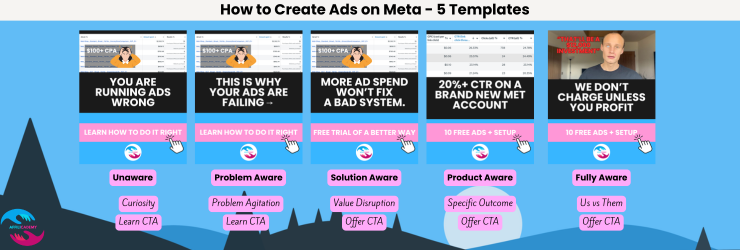
And yes, that offer is real. If you want it, fill out the form below.
https://affilicademy.com/10freeugc

FAQ
What is an ICP in business?
An ICP (Ideal Customer Profile) is a clear definition of the specific person or company that is the best fit for your product. It focuses on their problems, desires, and context rather than just demographics. A strong ICP helps guide messaging, positioning, and offer structure.
How detailed should my ideal customer profile be?
It should be detailed enough to understand how the person thinks and what they struggle with daily. You don’t need excessive attributes—just clarity on their situation, pain points, desired outcomes, and constraints. Over-detailing often reduces usability.
Can I have multiple ICPs for one product?
Yes, but not initially. Start with one primary ICP to build strong message-market match. Once you have consistent performance and data, you can expand into additional ICPs with tailored messaging.
How does an ICP improve ad performance?
A well-defined ICP improves how relevant your ads feel to the viewer. This increases engagement, click-through rate, and conversion rate, which lowers CPA and helps ad platforms optimize delivery more effectively.
Is an ICP only useful for ads?
No. An ICP influences your entire marketing system, including landing pages, offers, and sales messaging. Ads are just where the impact is most immediately visible.
What’s the difference between a target market and an ICP?
A target market is broad and demographic-based, while an ICP is specific and behavior-driven. The ICP focuses on the best-fit customer, not just anyone who could potentially buy.
Glossary
Conversion Rate
The percentage of users who take a desired action, such as making a purchase or signing up.
Customer Pain Point
A specific problem or frustration that a customer is actively trying to solve.
Ideal Customer Profile (ICP)
A detailed description of the exact person or business that is the best fit for a product or service.
Message–Market Match
The alignment between what your audience needs and how your message communicates the solution.
Cost Per Acquisition (CPA)
The average cost required to acquire one paying customer through advertising.
Scaling
The process of increasing ad spend while maintaining or improving performance metrics.