All Business Owners Need to Know These Metrics on Meta
What Metrics Matter Most in Facebook and Instagram Ads?
This article will showcase a real case study where Alex Hormozi spent millions on Meta ads using this framework, and the results. Skip to the Case Study
Key Takeaways
Creative interaction metrics are the primary signal that drives delivery in modern Meta advertising.
In 2026, Advantage+ campaigns powered by Andromeda determine audience distribution largely through how users interact with creative assets, meaning engagement signals directly influence where ads scale.
Conversion metrics matter only after creative-market alignment has been validated.
Purchases and cost-per-acquisition are outcome metrics, but without upstream creative interaction signals, Meta’s system lacks the data required to distribute ads effectively.
Creative testing capacity determines long-term campaign performance.
Operators who produce and test large volumes of creative variations generate stronger interaction data, which improves optimization and lowers acquisition costs over time.
Metrics must be interpreted as part of a system rather than in isolation.
CTR, conversion rate, and CPA are interconnected outputs of message alignment, creative testing structure, and signal density. This means that if you attempt to look at each one in isolation, you will usually draw an inaccurate conclusion from the data, and make the wrong decision.
The most important Meta Ads metric is profitability. Everything else is helping you get that metric.
The entire point of meta ads, from awareness to purchase, is to increase the net profitability of a business. CTR, CPM, Conversion Rate, etc. all are ways that you can get to profitability faster, and increase it.
The rest of this article will focus on how to improve metrics, now that you know the most important things to remember. The end of this article will have a diagnostic framework to evaluate and improve metrics.
Skip ahead using the Table of Contents:
Introduction - How to Look at Metrics.
Common Structural Mistakes and Misconceptions
Why Most Efforts Collapse at Scale
Case Study on How This Works in the Real World - Not Just Theory
How to Evaluate Your Facebook and Instagram Ad Metrics (5-Step Diagnostic Framework)
Step 1: Evaluate CTR (Click-Through Rate)
Step 2: Evaluate Engagement Rate
Step 3: Evaluate Video Watch Time or Scroll-Stop Rate
Step 4: Evaluate Conversion Rate
Step 5: Evaluate Cost per Acquisition (CPA)
If you Prefer Videos, We Made This One For You
This is the video, created after this article, which is a video format version of the article. Same information, same value. It includes the case study as well. If you prefer to watch instead of read, its a great option.
Introduction - How to Look at Metrics.
When you are attempting to optimize metrics on Meta ads, you have to remember that all of them work together. Each metric does represent a specific audience reaction (CTR for example showcases what level of motivation the audience has to take your showcased offer) but each can be misrepresented by thinking of each independently.
CTR, while it usually showcases motivation, can also showcase message alignment. If you are trying to sell bibles to an atheism convention, your sales will be a lot worse than if you sell them at a church.
So, a lot of this article will focus on how to evaluate the total throughput of metrics to understand how they relate to each other, and what you should focus on first when testing.
Modern Meta advertising infrastructure does not operate like a manual targeting platform. Since the introduction of Advantage+ campaigns and the expansion of the Andromeda delivery architecture, Meta’s algorithmic distribution system determines audience targeting automatically. Instead of relying heavily on manual audience segmentation, the platform now uses creative interaction signals to determine which audiences should see an ad.
This change fundamentally alters the role of advertising metrics.
Metrics are no longer simply performance indicators; they are feedback signals that train the distribution system. When an ad receives strong engagement signals, such as high click-through rates, long watch time, and strong conversion behavior, Meta’s system expands delivery toward similar audiences. When signals are weak, distribution contracts.
Therefore, the question “What metrics matter most in Facebook and Instagram ads?” actually will lead you to the realization that Meta will optimize almost all of your metrics automatically, and that you need to focus on the actual images and videos (creatives) that are in the ad account.
This article explains the mechanism behind Meta advertising metrics, the structural mistakes that cause most campaigns to fail, and the strategic framework used to interpret metrics correctly within a modern Advantage+ advertising system, which leverages the most advanced targeting algorithm in the world, Andromeda. (Meta released andromeda in 2025 as a part of their biggest ad update ever.)
This is important for getting accurate insight into what metrics matter most in Facebook and Instagram ads because metrics only become meaningful when interpreted within the algorithmic feedback system that generates them.
If you want to improve results, this is what you need to do.
The Core Mechanism Behind Facebook and Instagram Advertising Metrics
The most important metrics in Facebook and Instagram advertising are those that generate high-quality interaction signals for Meta’s delivery system. Modern Meta campaigns operate through a signal-based optimization loop where creative assets present a specific problem, outcome, or benefit to a defined audience.
When that message resonates, users interact with the ad by watching, clicking, commenting, sharing, or converting. These interactions create signal density, which Meta’s algorithm interprets as evidence that the ad is relevant to a particular type of user, prompting the platform to expand delivery toward similar behavioral audiences.
Because of this, metrics like CTR, engagement rate, and conversion rate should not be viewed as standalone optimization targets. Instead, they serve as evidence that a message resonates with a particular audience segment.
Interaction signals (CTR, engagement, watch time) show whether the creative captures attention and communicates relevance, conversion signals (conversion rate, CPA) reveal whether the offer turns interest into action, and distribution signals (reach, frequency, CPM) reflect how the algorithm scales delivery based on those interactions.
This is important for getting accurate answers about what metrics matter most in Facebook and Instagram ads because the most valuable metrics are those that strengthen the signal loop powering Meta’s algorithmic distribution.
What if Meta Interprets These Signals Wrong?
This happens more than you would think - but specifically when one thing that you can control happens first.
If you upload a video to your ad account that is very funny, generates a ton of engagement, but doesn't relate to your product, Meta will think it is an amazing ad because of the soft engagement metrics (CTR, CPM, Engagement Rate) but it will never drive heavy purchase intent.
This will make it so that Meta over-spends on an ad that will never be profitable.
So your job is to pre-evaluate if an ad is a good choice by the likelihood that it convinces people to purchase. Meta struggles with this more than you will.
Common Structural Mistakes and Misconceptions
Many advertisers misunderstand Meta advertising metrics because they interpret dashboard numbers without understanding the system producing them. This leads to several recurring structural mistakes.
Mistake 1: Treating CPA as the primary optimization lever
Many operators assume cost per acquisition is the most important Facebook advertising metric. In reality, CPA is a lagging indicator. By the time CPA changes, the underlying creative and interaction signals have already shifted.
The correct approach is to monitor interaction signals first, because they indicate whether the ad is likely to scale before conversion data accumulates.
This assumes that you chose an ad that will actually convince someone to purchase. If it is just interesting, this won't be accurate. The way to know if this is the case after running an ad is if all of your engagement and click stats are good, but your purchase stats are bad.
Mistake 2: Running too few creative variations
Meta’s delivery system requires large amounts of interaction data to identify audience patterns. Campaigns with only one or two ads generate insufficient signal density, forcing the algorithm to make decisions with limited data.
High-performing advertisers test multiple creatives simultaneously, allowing the system to evaluate different messages and formats rapidly. When I say multiple I mean anywhere from 10 to 50+ ads.
Mistake 3: Over-optimizing the ad set
In older Facebook advertising frameworks, advertisers spent significant time refining audience targeting. However, Advantage+ campaigns rely primarily on creative signals for targeting decisions.
Attempting to micro-manage audiences through ad sets often reduces algorithmic learning capacity and limits performance.
Mistake 4: Changing variables too frequently
Many advertisers react to early performance fluctuations by editing campaigns repeatedly. Every significant change resets parts of the learning process, reducing signal stability.
Structured testing requires isolating variables and allowing the algorithm sufficient time to collect reliable interaction data. "Sufficient time" is actually based on your budget.
When people ask "Is $5 a day enough for Meta ads?" Technically it is. It just means you need to wait way longer to change things. I recommend spending between $250 - $1,000 before making changes in an ad account. Divide this amount by your daily budget to know how much "sufficient time" is for you.
Mistake 5: Ignoring creative fatigue signals
Metrics such as declining CTR, rising frequency, and decreasing engagement often indicate that audiences have already consumed the available creative inventory. Instead of adjusting targeting, the correct response is typically to introduce new creative variations.
These mistakes persist because advertisers interpret metrics as tactical instructions rather than signals within a structured testing system. Always remember metrics work together. Creative volume can solve almost all of them at once if you test accurately.
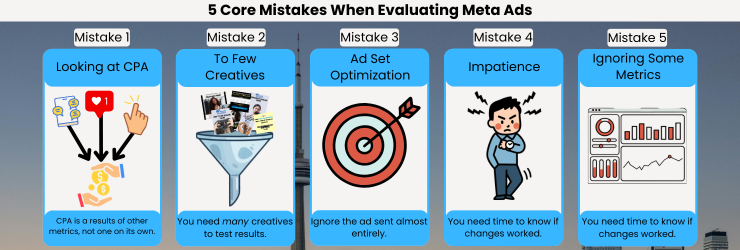
This is important for getting accurate insight into what metrics matter most in Facebook and Instagram ads because misinterpreting metrics leads to structural mistakes that prevent the algorithm from producing reliable performance data.
Why Most Efforts Collapse at Scale
Campaigns that appear profitable at low budgets often collapse when spend increases. This is not because the product suddenly stops working, but because the campaign structure lacks the creative capacity required for scale.
When a campaign operates with only a few creative assets, the algorithm quickly exhausts the high-response portion of the audience. As frequency increases, engagement declines and performance deteriorates.
As budgets increase, the algorithm must deliver ads to broader audiences. If creative messaging is not strong enough to resonate beyond the initial high-intent segment, engagement signals weaken and distribution efficiency declines.
This creates a negative feedback loop:
Higher spend → weaker interaction signals → lower algorithm confidence → higher costs.
Many advertisers mistakenly interpret this as an audience saturation issue, when the real constraint is creative volume.
Case Study on How This Works in the Real World - Not Just Theory
A note from the Author: If you are spending anything less than millions on ads, you do not have audience saturation. Alex Hormozi spent millions in ads on his book launch, profitably, within months. Then had the world record for non-fiction book sales at a launch. RUN MORE ADS.
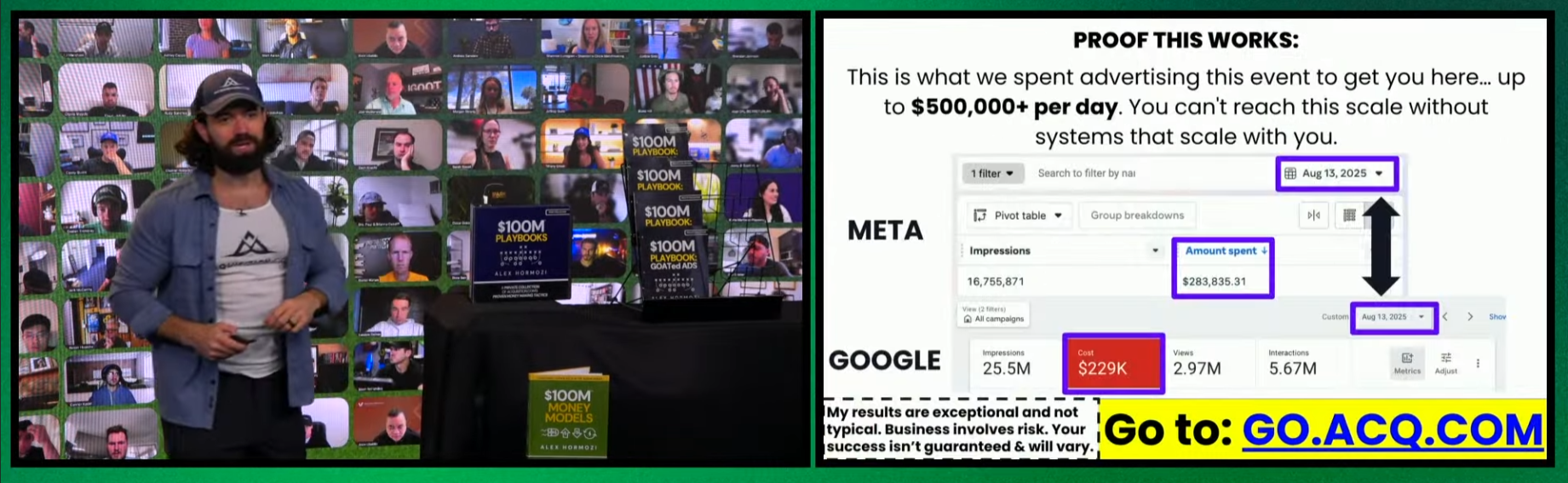
(This screenshot showcases the ad spend for the book launch from August 13th, where they spent half a million dollars on ads in a single day.)
Time Stamp - 1:16:23 when you click on the image.
Scaling therefore requires a parallel increase in creative testing capacity. Each new creative variation introduces additional interaction signals, allowing the algorithm to identify new audience segments with similar behavioral patterns.
Here, Alex Hormozi showcases that they created 1,452 ads for their launch (the one that spent millions.) So, no, they did not just "find a winning ad" and increase the budget.
This is the system that works.
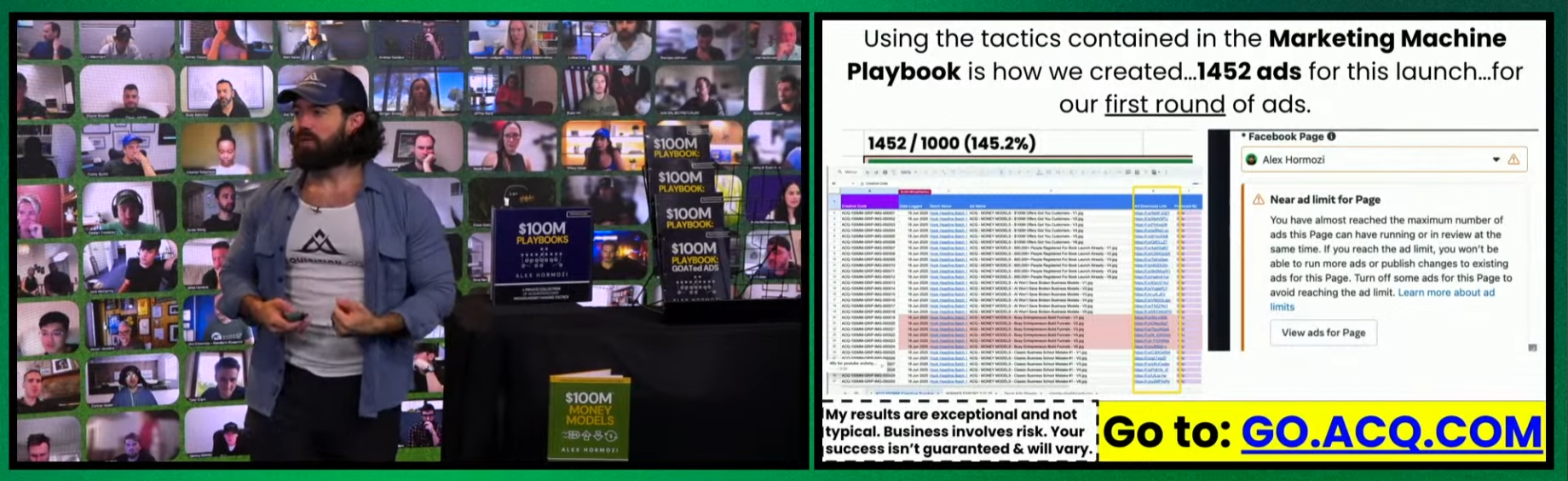
Time Stamp - 1:16:59 when you click on the image.
Advertisers who scale budgets without increasing creative capacity eventually encounter frequency compression, declining CTR, and rising CPAs.
Conversely, advertisers who continuously introduce new creative variations maintain signal density even as budgets grow. (which means they stay profitable)
This is important for getting accurate understanding of what metrics matter most in Facebook and Instagram ads because scaling performance depends on maintaining strong interaction signals as delivery expands.
This system drove $106,000,000 in sales in 72 hours. It works.
The Correct Strategic Framework
A stable Meta advertising system is built on structured testing, creative capacity, and disciplined iteration. Within the Affilicademy methodology, this approach aligns with the broader SCALER framework, where performance growth results from systematic improvements in signal quality and testing capacity.
The first component is precise ICP definition. Creative assets must address a specific audience problem or desired outcome. Broad messaging produces weak interaction signals, while targeted messaging generates stronger engagement data.
The second component is single-problem campaign structure. Each campaign should focus on one core audience pain point. This clarity improves signal density because users who resonate with the problem are more likely to interact with the creative.
The third component is a controlled creative testing matrix. Instead of random experimentation, operators systematically vary elements such as hooks, visual style, messaging angle, and proof format.
The fourth component is defined performance thresholds. Interaction metrics determine which creatives remain in rotation. Ads that fail to generate sufficient engagement signals are replaced quickly.
The final component is iteration cycles before aggressive scaling. Campaigns must demonstrate stable interaction and conversion signals before budgets increase.
When this system operates correctly, creative testing generates stronger interaction signals, which improve algorithmic distribution. Better distribution lowers acquisition costs, which increases profitability and allows further reinvestment into creative production.
Over time, this creates a compounding feedback loop in which creative capacity drives sustainable performance growth.
This is important for getting accurate results when evaluating what metrics matter most in Facebook and Instagram ads because only structured systems can generate reliable interaction signals for Meta’s algorithm to optimize effectively.
How to Evaluate Your Facebook and Instagram Ad Metrics (5-Step Diagnostic Framework)
Understanding what metrics matter most in Facebook and Instagram ads is only useful if you know how to evaluate them systematically. Most advertisers open Ads Manager, see dozens of numbers, and attempt to optimize everything simultaneously. This approach creates variable chaos and produces unreliable conclusions.
Instead, metrics should be interpreted sequentially. Each metric represents a specific audience behavior signal that reveals how the market is responding to your creative, message, and offer.
When evaluated in the correct order, these metrics form a diagnostic pipeline that allows you to isolate the exact failure point in your advertising system.
Note: yes, all of these still work together. Creatives will affect all stats at the same time. This process just helps you understand what each stat likely means so you can have direction to improve them.
The following five-step evaluation process translates key Facebook and Instagram advertising metrics into audience meaning, then explains how to improve each metric within a structured campaign framework.
Step 1: Evaluate CTR (Click-Through Rate)
Audience Meaning: Motivation and Message Resonance
CTR represents the percentage of viewers who decide to leave the platform after seeing your ad.
In behavioral terms, CTR measures two things:
• How strongly the creative captures attention in the feed
• How compelling the message is relative to the audience’s existing problem awareness
When CTR is high, it indicates the ad has successfully created enough motivation for users to interrupt their scrolling behavior and explore the offer further.
When CTR is low, the audience is effectively signaling that the ad is not relevant, not interesting, or not clearly communicating value.
How to Improve CTR
Improving CTR requires increasing the ad’s attention capture and message clarity, not adjusting targeting.
The most effective improvements typically include:
• Stronger hooks in the first two seconds of video or the first visual frame
• More explicit problem identification in the headline or opening line
• Clearer promise of a specific outcome
• Pattern-interrupt visuals that stand out in the feed
Most CTR improvements come from creative iteration, not copy tweaks. Testing multiple hooks and visual formats generates stronger interaction signals that help the algorithm identify receptive audiences.
Step 2: Evaluate Engagement Rate
Audience Meaning: Depth of Interest and Emotional Relevance
Engagement metrics, likes, comments, shares, and saves, indicate how strongly the audience identifies with the content of the ad.
While CTR measures motivation to explore further, engagement signals measure how personally relevant the message feels.
High engagement often indicates the ad reflects a problem, identity, or aspiration that viewers recognize in themselves. When this occurs, users interact with the content even if they do not immediately click.
Low engagement suggests the creative may still generate curiosity clicks but does not create meaningful emotional alignment with the audience.
How to Improve Engagement
Engagement improves when creative content feels authentic and audience-specific.
Effective improvements include:
• Demonstrating the real-world problem your audience experiences
• Using relatable storytelling or creator-style content
• Incorporating social proof or shared frustrations
• Speaking directly to a niche audience identity
In practice, ads that feel like content from a creator rather than a brand advertisement tend to produce stronger engagement signals. This is why under-produced ads often outperform highly edited ads.
Step 3: Evaluate Video Watch Time or Scroll-Stop Rate
Audience Meaning: Attention Retention
If your ads include video or motion creatives, watch time measures how effectively the ad maintains viewer attention after the initial hook.
An ad may achieve a high CTR because the hook creates curiosity, but if viewers quickly abandon the content, the message is likely unclear or poorly structured.
Watch time signals help the algorithm determine whether your creative should continue being distributed widely.
How to Improve Watch Time
Improving watch time requires restructuring the creative narrative:
• Deliver the core problem immediately rather than building slow context
• Maintain visual motion and pattern changes throughout the video
• Introduce proof or results earlier in the ad
• Avoid long brand introductions before delivering value
Strong watch time signals indicate that the audience finds the content valuable enough to continue watching.
Step 4: Evaluate Conversion Rate
Audience Meaning: Offer Acceptance, and Value
Conversion rate measures how many users who clicked actually take the desired action, such as purchasing, submitting a lead form, or booking a call.
In audience-behavior terms, conversion rate answers a simple question:
After learning more about the offer, does the audience believe it is worth acting on?
If CTR is strong but conversion rate is weak, the problem is rarely the ad itself. Instead, it usually indicates:
• Offer misalignment
• Weak landing page messaging
• Pricing resistance
• Lack of trust or proof
How to Improve Conversion Rate
Improving conversion rate requires strengthening the offer and proof structure, not the ad targeting.
Effective improvements often include:
• Clarifying the core benefit or transformation
• Adding testimonials or customer case studies
• Reducing friction in the purchase or signup process
• Aligning landing page messaging with the ad’s promise
The key principle is consistency: the landing experience must deliver exactly what the ad promised.
This is important for getting accurate insight into what metrics matter most in Facebook and Instagram ads because conversion rate reveals whether your offer actually satisfies the expectations created by your ad.
Step 5: Evaluate Cost per Acquisition (CPA)
Audience Meaning: Market Efficiency
CPA represents the total cost required to acquire a customer or lead.
However, CPA is not a direct optimization lever. It is a composite outcome created by the previous metrics:
• CTR determines how many users enter the funnel
• Engagement and watch time determine signal quality
• Conversion rate determines offer acceptance
When these upstream metrics improve, CPA naturally decreases because the system operates more efficiently.
How to Improve CPA
The most reliable way to reduce CPA is to strengthen upstream metrics rather than manipulating budgets or audiences.
This typically involves:
• Launching additional creative variations to increase interaction signals
• Improving message clarity around the core audience problem
• Strengthening landing page proof and trust signals
In other words, CPA improves when the entire advertising system becomes more aligned with the market.
The Diagnostic Flow of Meta Ad Metrics
When these five metrics are evaluated in sequence, they create a clear diagnostic pathway:
Each stage reveals a specific behavioral response from the audience. Instead of guessing why performance changes, advertisers can identify the exact structural bottleneck in their campaign.
For example:
Low CTR → Creative message problem
High CTR but low conversion → Offer or landing page problem
High conversion but rising CPA → Creative fatigue or signal decay
This diagnostic approach transforms metrics from confusing dashboard numbers into behavioral signals that explain exactly how audiences respond to your advertising system.
Strategic Synthesis
Throughout this article, we examined what metrics matter most in Facebook and Instagram ads by reframing them as outputs of a system rather than isolated dashboard numbers. We saw how modern Meta advertising uses interaction signals such as CTR, engagement rate, and watch time as feedback that trains the algorithm to identify and expand toward responsive audiences.
Conversion metrics like conversion rate and CPA were shown to be downstream outcomes of this signal loop, not independent optimization levers. The analysis also demonstrated why creative testing capacity is the primary driver of scalable performance, how structural mistakes like over-optimizing ad sets or running too few creatives distort metric interpretation, and how metrics should be evaluated sequentially to diagnose audience behavior.
To support this, the case study of Alex Hormozi illustrated this system operating at scale, where thousands of creative variations and massive ad spend generated strong interaction signals that allowed Meta’s algorithm to distribute ads efficiently and produce extraordinary sales volume.
Together, these examples reinforced the central point: the metrics that matter most in Facebook and Instagram ads are the ones that strengthen the interaction signal loop that ultimately drives profitable distribution.
If you follow this system, you will also have fantastic results.
What Do I Do Next?

You have learned so much during this article, and I only have one offer for you. If you want a free trial, where I will implement all of this for you, and then have a performance based pricing structure after, consider filling out the form with the link here.
https://affilicademy.com/10freeugc
This is your chance to stop guessing which metrics matter and start running Meta campaigns that actually scale profitably, using the same structured system and creative testing framework that drives results at Affilicademy.
FAQ
What metrics matter most in Facebook and Instagram ads?
The most important metrics are interaction signals such as click-through rate, video watch time, and engagement rate because they determine how Meta’s algorithm distributes ads to audiences.
What is the most important metric in Facebook ads?
No single metric operates independently, but CTR combined with conversion rate is often the clearest indicator of strong message-to-market alignment.
What are key metrics to measure the performance of Facebook and Instagram posts?
Engagement rate, video watch percentage, click-through rate, and conversion rate provide insight into how effectively content captures attention and drives action.
What are the five most important metrics for Meta ads performance?
Click-through rate, engagement rate, conversion rate, cost per acquisition, and frequency together provide a complete view of interaction signals, economic outcomes, and delivery dynamics.
What does a Meta Ads metrics list typically include?
A comprehensive metrics list includes reach, impressions, CTR, CPC, CPM, engagement rate, conversion rate, CPA, and return on ad spend.
What are Facebook advertising benchmarks?
Benchmarks vary by industry, but high-performing campaigns typically maintain CTR above 1.5–2%, stable conversion rates, and CPAs aligned with customer lifetime value.
How often should I check Facebook Ads metrics?
Performance metrics should be reviewed daily for major shifts, but structural decisions such as creative replacement or scaling should occur after sufficient data accumulation, typically every 3–5 days.