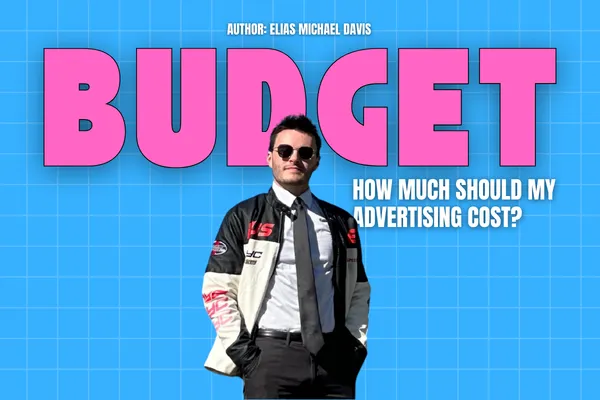
How much should I budget for a small business ad campaign?
How Much Should I Budget for a Small Business Ad Campaign?
Introduction
How much should I budget for a small business ad campaign?
This question is asked 165,000 times per month on Google, and almost always answered incorrectly.
Most responses default to percentages of revenue, arbitrary monthly ranges, or vague benchmarks about “what other small businesses spend.” That framing is fundamentally flawed. Budgeting for paid media is not a percentage game. It is a data acquisition and capital allocation problem.
Comparing yourself to industry averages also means that you are only better than half of businesses. You are also worse. Stop looking at industry averages. We want to be great.
When small businesses fail with paid ads, it is rarely because “ads don’t work.” It is because they undercapitalize the testing phase, miscalculate their target CPA, or prematurely withdraw capital before the system has enough signal to optimize. The failure is structural.
Instagram advertising cost, Facebook ad CPMs, and monthly media budgets are variables. The mechanism that determines success is whether your budget is sufficient to generate statistically useful data, and whether you reinvest profit to compound performance.
So to answer the question, your budget does have guidelines, but should be as much as possible, here is why:
In this article, we will break down:
How to determine marketing budget based on target CPA, not guesswork
What a good advertising budget for a small business actually means in practice
How much advertising costs for a small business per month when structured correctly
Why you should budget at minimum 5x your target CPA weekly to generate usable data
Why profit reinvestment is what allows real scaling
If you understand the underlying mechanism, budgeting stops being emotional and becomes mathematical. It also stops feeling like a cost and more like an investment.
The Core Mechanism Behind Instagram Ad Budgets
The central mistake in answering “How much should I budget for a small business ad campaign?” is assuming the budget is a static monthly number.
Budget is not a static number. It is the fuel required to generate statistically valid conversion data.
Every paid social campaign operates under three structural constraints:
Cost per thousand impressions (CPM)
Click-through rate (CTR)
Conversion rate (CVR)
From those three inputs, your cost per acquisition (CPA) emerges.
If your target CPA is $100, and you want to know how much to spend, you must reverse engineer how much capital is required to generate enough conversions to validate whether your CPA is achievable.
At Affilicademy, the minimum viable weekly testing budget is 5x your target CPA.
If your target CPA is $50, your weekly testing budget should be at least $250.
Why?
Because a single conversion proves nothing. Three conversions are enough to prove you have a viable offer. Five to ten conversions begin to provide directional data, that can be used to improve ads and profitability over time. Below that threshold, platform optimization has insufficient signal to stabilize delivery.
Most small businesses ask:
“How much does advertising cost for a small business per month?”
The more important question is:
“How much do I need to spend weekly to generate statistically usable data?”
And
“How much money do I want to generate monthly from ads?”
If your weekly budget cannot produce at least 5 conversions at target CPA, you are not able to generate usable data, improve, and stop dealing with massive flux on ads weekly.
Common Mistakes / Misconceptions
Mistake 1: Underinvesting in Instagram Ads
Why people make this mistake
Small businesses are risk-averse with paid media. They test with $10–$20 per day and expect immediate validation. The assumption is that starting small minimizes risk.
What actually happens in practice
With a low daily budget, campaigns struggle to exit learning phases. The algorithm cannot find stable audiences. CPM volatility becomes exaggerated. Performance swings wildly based on a handful of conversions.
When someone asks, “How much should I budget for a small business ad campaign per month?” and the answer is $300, what they’re really saying is: “I am comfortable gathering insufficient data.”
Low budgets create false negatives. Ads are paused before they mature.
What the correct structural approach looks like
Calculate your target CPA first.
Multiply it by 5.
That is your minimum weekly testing threshold.
If your target CPA is $80, your testing budget should be at least $400 per week. If you cannot deploy that capital, delay paid media until you can. Otherwise, you are not running a serious acquisition system. More is better, but that is the minimum.
Mistake 2: Failing to Set Measurable Budget Goals Such as CPA
Why people make this mistake
Many small businesses determine budget based on “what feels affordable” rather than what the unit economics require.
They ask:
“What is a good advertising budget for a small business?”
The real answer depends entirely on target CPA and customer lifetime value (LTV).
What actually happens in practice
Without a defined CPA target, campaigns drift. Teams celebrate vanity metrics like impressions and reach. Monthly budgets get consumed without understanding profitability.
You cannot answer “What is the budget for advertising campaigns?” without defining:
Target CPA
Break-even CPA
LTV
Contribution margin
Your budget should be determined by how much revenue you want to make, and how much capital you have to invest.
What the correct structural approach looks like
Start with LTV.
If your average customer generates $1,000 in lifetime value and your margin allows for $300 in acquisition cost, your maximum CPA is $150 to have a viable business model.
Then determine your target CPA (for example, $150).
Now apply the 5x weekly rule.
Weekly testing budget = $750.
Monthly testing baseline = $4,000 minimum.
This is how you determine a marketing budget. It is reverse engineered from allowable acquisition cost.
Mistake 3: Not Reinvesting Profit and Taking Advantage of High ROAS
Why people make this mistake
Small businesses often treat paid ads as an expense rather than a capital deployment vehicle. When campaigns become profitable, they extract profit instead of compounding it.
What actually happens in practice
Campaigns hit profitability. Owners withdraw surplus cash. Spend remains static. Competitors increase spend and gain impression share. Momentum stalls.
If your Instagram advertising cost yields a 3x return, and you do not increase budget, you are choosing linear stagnation over exponential growth.
What the correct structural approach looks like
As long as your CPA remains below target and creative iteration is active, reinvest profit.
Paid acquisition becomes a flywheel:
Profit → Increased budget → More data → Better optimization → Higher stability → Increased scale.
The moment you stop reinvesting, the compounding effect stops.
Why Most Efforts Collapse at Scale / Advanced Pitfalls
Scaling introduces structural constraints that small budgets hide.
When spend increases:
Audience saturation increases
Frequency rises
Creative fatigue accelerates
CPMs often climb
Small campaigns can survive mediocre creative because they operate within narrow audience pockets. Large campaigns cannot.
When businesses scale without structured creative iteration, performance decays.
Another collapse point is operational capacity. Lead volume increases faster than fulfillment systems. Sales teams become bottlenecks. Conversion rates drop, inflating CPA.
Scale does not break because “Instagram ads stopped working.” It breaks because:
Creative production capacity is insufficient
ICP targeting becomes diluted
Backend systems cannot handle increased volume
Budget alone does not create scale. Infrastructure does.
The Correct Strategic Framework / Step-by-Step Approach
To answer “How much should I budget for a small business ad campaign?” correctly, you need a system.
Step 1: Define ICP and Economic Boundaries
Clarify:
Ideal customer profile
LTV
Acceptable CPA
Break-even CPA
Without these numbers, budget decisions are arbitrary.
(More information on ICP development here https://affilicademy.com/post/highconvertingads)

Step 2: Reverse Engineer Minimum Viable Budget
Apply the 5x weekly rule:
Minimum Weekly Budget = Target CPA × 5
This ensures enough conversions to evaluate performance directionally.
If your CPA target is $60:
Weekly testing budget = $300
Monthly baseline = ~$1,200–$1,500
This is how you answer “How much does advertising cost for a small business per month?” with precision.
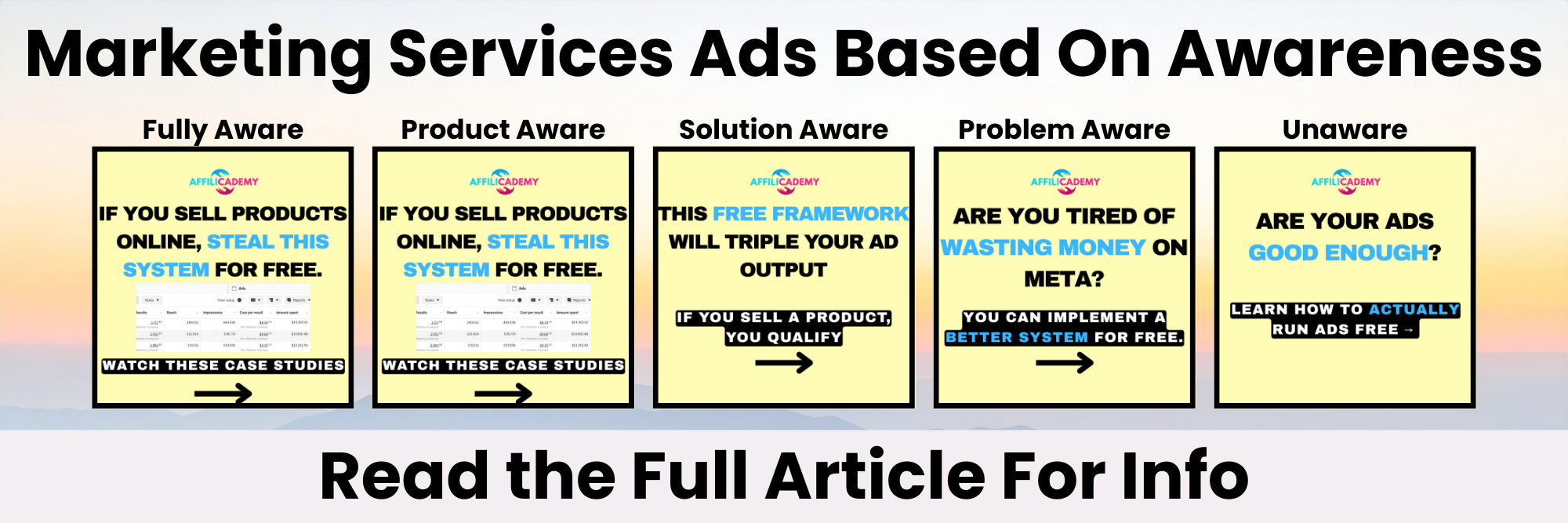
Step 3: Structure Campaigns by Awareness Stage
Do not lump all messaging into one campaign.
Create:
Problem-aware campaigns
Solution-aware campaigns
Product-aware retargeting campaigns
Each stage should have its own budget allocation and CPA expectations.
This segmentation stabilizes data and improves optimization clarity.
(In depth analysis on this article for awareness stages and how they effect messaging: https://affilicademy.com/post/advertising)
Step 4: Controlled Creative Testing
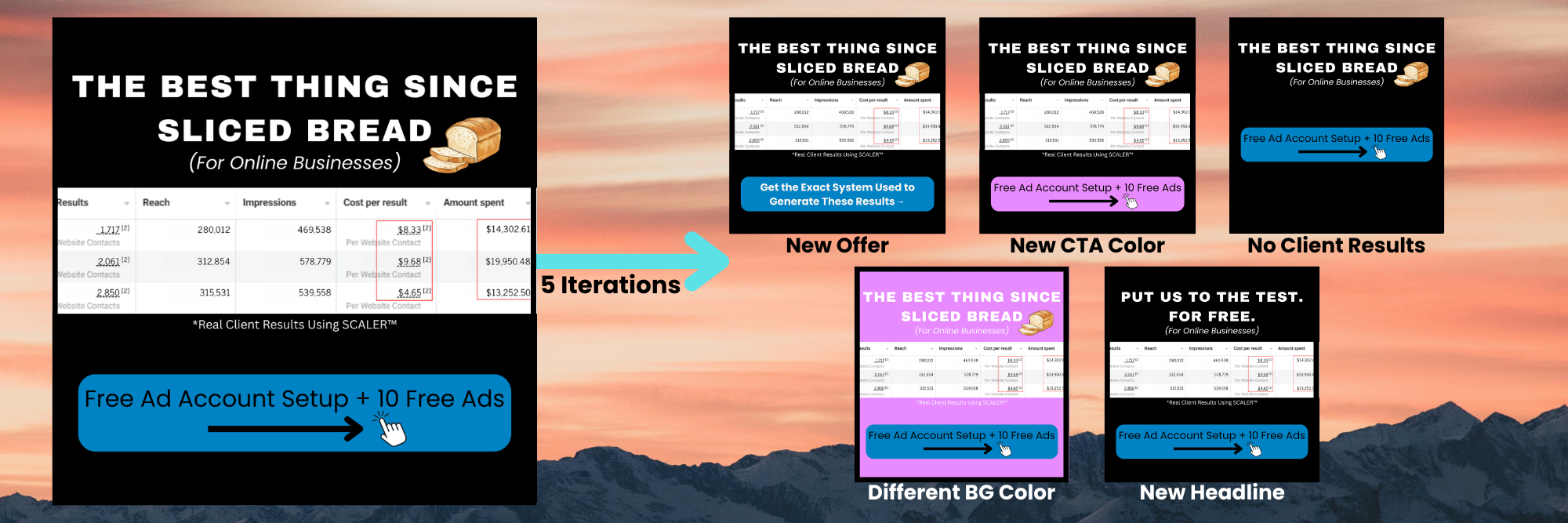
Budget without creative testing is waste.
Test:
One ICP per campaign
One angle per creative set
Static-first variations before complex formats
Do not launch ten unrelated ideas simultaneously. Controlled variables produce actionable insight.
(iteration creative testing information: https://affilicademy.com/post/Iteration)
Step 5: Performance Thresholds
Define:
Minimum CTR benchmarks
Acceptable CPA range
Kill thresholds for underperforming creatives
If CTR falls below your threshold, iterate the hook.
If CPA exceeds tolerance after sufficient spend (5x CPA), pause and replace.
Discipline prevents budget bleed.
Step 6: Iteration Cycles Before Scaling
Do not scale the first profitable ad.
Run iteration cycles:
Identify winning angle
Produce 3–5 variations
Test against control
Replace weakest performers
Only when stability is demonstrated should budget increase incrementally.
(examples with creative iteration based on winning/losing ads: https://affilicademy.com/post/mistakes)

Step 7: Profit-Funded Expansion
Once campaigns operate below target CPA:
Increase budget 20–30% at controlled intervals
Monitor CPA stability
Reinvest surplus profit
Scaling should be funded by performance, not emotion.
How to Determine Marketing Budget in Practical Terms
If someone asks:
“What is the budget for advertising campaigns?”
The answer is conditional.
If your target CPA is $40:
Minimum weekly test budget: $200
Healthy monthly baseline: $800–$1,000
If your target CPA is $150:
Minimum weekly test budget: $750
Healthy monthly baseline: $3,000–$4,000
The real variable is not Instagram advertising cost. It is your acquisition tolerance.
Small businesses that treat paid ads like fixed expenses stagnate.
Small businesses that treat paid ads like scalable capital allocation engines grow.
Strategic Synthesis / Conclusion
How much should I budget for a small business ad campaign?
You should budget at minimum 5x your target CPA weekly to generate usable data.
You should structure campaigns around clear ICP definitions and awareness stages.
You should apply controlled creative testing and disciplined kill thresholds.
You should reinvest profit as long as CPA remains below target.
Budgeting is about capitalizing your data engine sufficiently to extract signal from noise.
That is how you determine marketing budget.
Not by comfort.
By mechanism.
If you are not Confident in Your Budget:
Fill out the form on this website, and Ill give you a free consult on what your budget should look like, as well as the ad creatives you need to scale an account efficiently.