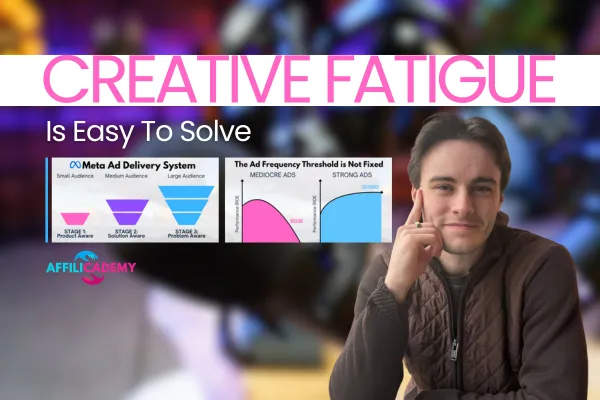
Creative Fatigue is Easy to Solve With This.
Would You Want to See the Same Ad 50 Times? 100? That is Creative Fatigue.
What Creative Fatigue Actually Is
Creative fatigue happens when a specific audience has seen a specific ad enough times that they've stopped responding to it. The technical term for this is frequency, how many times the average person in your audience has been served your ad. When frequency climbs too high without new creative entering rotation, engagement drops, CPMs rise, and Meta interprets the declining response as a signal that your ad is low quality. Delivery throttles. Costs go up.
Generally, by the time the numbers look obviously bad, the damage has been building for weeks.
This Article Has a Video Version!
I filmed this video as a version of this article where you can learn though video instead of reading. It has all the same content. Check it out!
The Ad Frequency Threshold Is Not Fixed
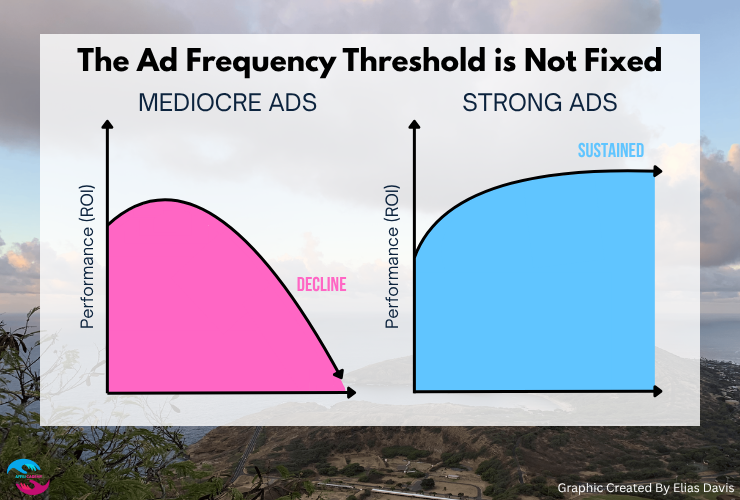
Here's what most people get wrong about ad fatigue statistics: there's no universal threshold where an ad dies. You'll see numbers thrown around, after three impressions, five impressions, seven, but those figures strip out the most important variable, which is the quality of the ad itself.
A mediocre ad can start losing performance at a frequency of two or three. A genuinely strong ad, one that's well-produced, speaks to real pain, and doesn't feel like an advertisement, can run at a frequency of six or eight before engagement falls off meaningfully. I've had creatives run for four months and stay profitable. I've had others die in two weeks. The difference was almost always the creative itself, not the budget or the audience size.
What this means practically is that creative fatigue solutions aren't just about rotation speed. They're about creative quality. A higher-quality ad buys you more time before fatigue sets in, which means lower costs and more runway before you need to produce something new.
I Learned This With a Health Supplement Account
Last year I was managing a campaign for a supplement brand - mid-range price point, decent margins, and one video ad that had been printing money for about six weeks. The hook was a real customer talking to a camera, casual and unconvincing in the way that actually convinces people. No studio setup, no script that sounded like a script. The CPA was clean and the ROAS justified the spend.
Then the numbers started softening. CTR dropped maybe twenty percent over two weeks. I extended the audience, adjusted the budget, looked at landing page metrics - nothing obvious. Eventually I pulled the frequency data and saw the core audience was sitting above a seven. That ad had reached most of the people it was going to reach. The ones still seeing it had already decided not to buy.
The fix wasn't complicated. We shot two new creatives that week - same format, different angles, different customers talking - and within ten days the numbers stabilized.
Why Better Ads Resist Fatigue Longer
There's a mechanism worth understanding here, and it's tied directly to how Meta's delivery system works. When you launch an ad, the algorithm identifies the people in your audience most likely to engage with it and converts them first. Those are your highest-intent buyers. They're the easiest to reach and the cheapest to convert. As the campaign runs, the pool of unreached high-intent buyers shrinks and the algorithm expands delivery into colder segments, people with lower purchase intent who need more convincing.
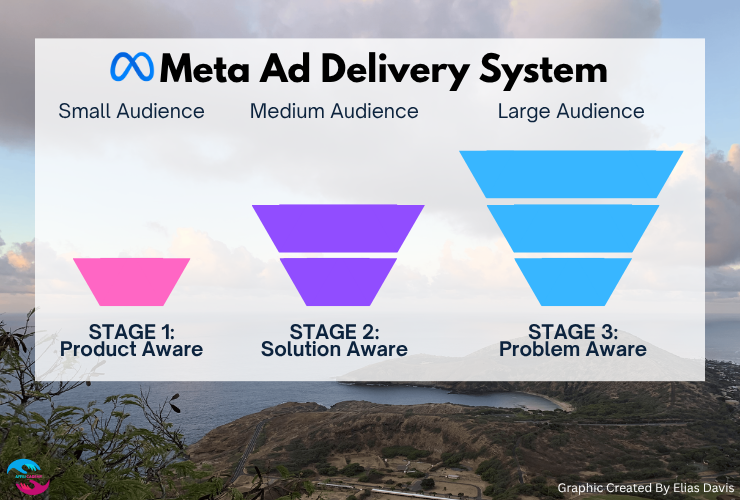
A weak creative that worked on warm audiences will fall apart with colder ones. A strong creative, something with a compelling hook, a clear reason to care, and delivery that doesn't feel like advertising, survives that transition because it can move colder audiences.
That can allow a much higher frequency before new ads are required.
The Two Levers You Actually Have
When creative fatigue starts showing up in your data, the solution lives in one of two places: volume or quality, usually both.
Volume means consistently introducing new creative. A rough ratio that's worked in practice is one new creative for roughly every five dollars of daily spend. At a hundred dollars a day, you're cycling in around twenty new variations per month. That gives the algorithm fresh material and keeps frequency from stacking on any single piece of creative. It doesn't need to be expensive to produce, the same casual, camera-to-face format that outperforms polished studio ads is also faster and cheaper to shoot. The volume game is more manageable than most people assume.
Quality means investing in understanding what makes a creative durable. Study what resonated in your top-performing ads, the hook, the framing, the emotional tone, and reverse-engineer it into new variations.
A great creative that runs at high frequency for two months at a low CPA is worth more than a dozen mediocre ones that need replacing every week.
The Mistake That Compounds Everything
The most common mistake I see is treating creative fatigue as a platform problem. The reasoning goes: Meta used to be cheaper, the algorithm worked better, something changed. Sometimes there's truth in this - CPMs have risen and competition has increased meaningfully. But the operators consistently producing results aren't doing anything different from what they were doing three years ago. They're making good creative and making a lot of it. That's been the answer the whole time.
The second mistake is misreading the signal. When CPA starts rising, the instinct is to blame the offer, the audience, or the landing page. All of those deserve investigation. But before rebuilding anything structural, check frequency.
The Honest Takeaway
Creative fatigue is not a mystery. It's a predictable outcome of showing the same thing to the same people until they stop responding. The meta ads creative fatigue solutions aren't complicated: make more ads, or make better ads, or - ideally - both. Better creative buys you more time before fatigue sets in. More creative gives the algorithm options when it does. The operators who run sustainable Meta campaigns understand this cycle and build around it. They don't wait for the numbers to collapse. They treat creative production as a continuous input, not a one-time task.
The platform works the same way it always has. The threshold for competing has risen, which means the old approach of setting up one great ad and hoping it runs forever doesn't hold anymore.
Don't Forget About the Free Trial!
If you are tired of high costs, a free trial is probably just what you need. I will run all of your ads, and then, once you get great results, we switch to a performance basis. Split the sales. 0 cost up front.
Learn more here:https://affilicademy.com/10freeugc
FAQ
What is creative fatigue in Meta ads? Creative fatigue occurs when a specific audience segment has been shown the same advertisement enough times that their engagement rate falls significantly. As frequency increases, click-through rates decline, CPMs rise, and Meta's algorithm begins throttling delivery because it interprets reduced engagement as a signal that the ad is low quality. The result is a gradual deterioration in campaign performance that can be easily misattributed to other variables.
What frequency level causes creative fatigue? There is no single frequency threshold that reliably predicts when an ad will fatigue. Lower-quality creative can begin losing performance at a frequency of two or three, while genuinely strong ads — particularly those that feel organic rather than produced — can maintain performance at a frequency of six, seven, or higher. Quality is the primary factor governing how long an ad remains effective before fatigue sets in.
What do ad fatigue statistics actually tell you? Aggregate ad fatigue statistics give you a baseline but strip out the most important context: how good the creative is and how targeted the audience is. A useful way to think about fatigue is as a ratio between creative quality and audience size. Smaller audiences fatigue faster. Better creative extends the window. Statistics that suggest a single threshold number are averaging across wildly different scenarios.
How do you fix creative fatigue without rebuilding your whole campaign? The simplest fix is introducing new creative into rotation before fatigue fully sets in, rather than after performance has already collapsed. You don't need to overhaul the offer, the targeting, or the campaign structure. New variations of your existing angle — same format, different hook, different spokesperson — give the algorithm fresh material to test against and prevent frequency from stacking on any single ad. Address the symptom directly before assuming something structural is wrong.
How much new creative do you actually need to run? A practical ratio is one new creative per five dollars of daily spend, evaluated monthly. At a hundred dollars daily, that's around twenty new variations per month. This keeps frequency manageable and ensures the algorithm always has fresh material to optimize against. The good news is that the creative format that tends to perform best — authentic, low-production, direct-to-camera — is also the least expensive and time-consuming to produce.
Can better creative actually prevent fatigue, or just slow it down? Better creative slows fatigue significantly, but doesn't prevent it entirely. Every creative will eventually reach the end of its viable audience. The strategic advantage of strong creative is that it extends the effective window long enough to produce meaningful returns before replacement is necessary, and it can continue converting as the algorithm expands into colder audience segments where weaker ads tend to fail.
Glossary
CAC (Customer Acquisition Cost): The total advertising spend required to generate a single new customer, calculated by dividing total ad spend by the number of customers acquired in a given period. Full article
Conversion Rate: The percentage of users who complete a desired action — such as a purchase — after clicking on an ad, reflecting landing page effectiveness and offer alignment. Full article
CPA (Cost Per Acquisition): The cost required to generate one conversion event, calculated by dividing total ad spend by the number of conversions. Related to but distinct from ROAS. Full article
CPM (Cost Per Thousand Impressions): The price paid for one thousand ad impressions, determined by auction dynamics, audience competition, and engagement signals. CPM is largely outside the advertiser's direct control. Full article
CTR (Click-Through Rate): The percentage of people who click on an ad after seeing it, used as an indicator of creative relevance and audience resonance. Full article
Frequency: The average number of times a unique user has seen a specific ad within a given time window. High frequency — typically above three — is associated with ad fatigue and declining engagement. Full article
Learning Phase: The initial period after a campaign is launched during which Meta's algorithm gathers conversion data to optimize future delivery. Campaigns typically need a set number of conversion events to exit this phase and stabilize. Full article
LTGP (Lifetime Gross Profit): The total profit a customer generates over their entire relationship with a business, calculated after subtracting cost of goods sold. Used in LTGP to CAC analysis to measure true profitability. Full article
LTGP to CAC Ratio: A profitability metric comparing lifetime gross profit per customer to the cost of acquiring that customer. A more complete measure of marketing efficiency than ROAS alone. Full article
ROAS (Return on Ad Spend): A performance metric calculated by dividing revenue generated from ads by the total amount spent. Expressed as a multiple, such as 3x or 4x, indicating dollars returned per dollar spent. Full article
UGC (User-Generated Content): Ad creative that mimics or uses real customer-created content, characterized by casual production quality and direct, unscripted delivery. UGC-style ads tend to resist fatigue longer than polished, produced alternatives because they do not trigger the instinctive avoidance response associated with traditional advertising.