You Don't Need AI to Make The Best Ads
Mastering Organic Authenticity Instead of an AI Slop Fest is the Key to Success.
Why the Ugliest Ads Often Win
The ads that perform best right now look like they were made by someone who didn't know what they were doing. I know how that sounds. But stick with me for a second, because once you see it, you can't unsee it, and it changes how you think about every dollar you spend on creative.
The Video Version of This Article:
I filmed this for people who prefer to watch, instead of read.
70% of People Hate Ads
Seventy percent of people hate ads. Not in a passive way. In a "I will pay a monthly subscription to avoid them" way. That's the audience you're buying media against. So when you spend $10,000 on a polished production with clean lighting and a professional voiceover, you're not just spending money on creative. You're spending money on something that the majority of your audience has trained themselves to skip before it even finishes loading.
The brain does this automatically. It's not a decision. After years of scrolling, most people have built a near-instant pattern recognition for ad content. Certain visual cues, certain production qualities, certain camera movements, they all fire the same alarm: this is an ad, keep scrolling. Your audience doesn't choose to ignore you. They just do.
What Happened in My Hotel
A few years back I was running paid media for a supplement brand out of Austin. We had two creatives going into a split test. One was a proper studio shoot: model, clean backdrop, branded transitions, the whole thing. Cost about $4,000 all in. The other was a two-minute video I shot in my hotel on my phone, in a t-shirt, one take, no script, just me talking about why I'd started using the product.
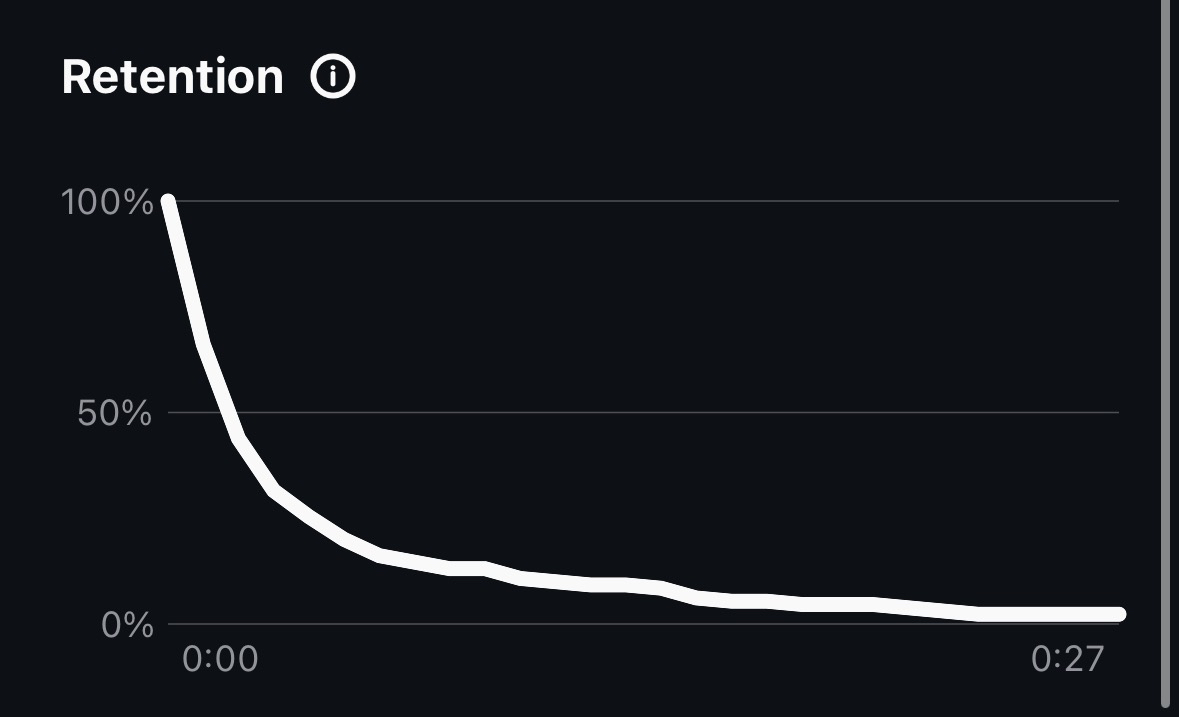
By day three the hotel video had a CTR nearly three times higher and a CPA around 40% lower. The studio ad was getting impressions. It just wasn't getting watched. People saw the first frame and were gone, because that first frame looked exactly like the first frame of every other ad they'd scrolled past that week.
The hotel video on the other hand looked like something a friend sent you. So people watched it.
The Two Things Going On
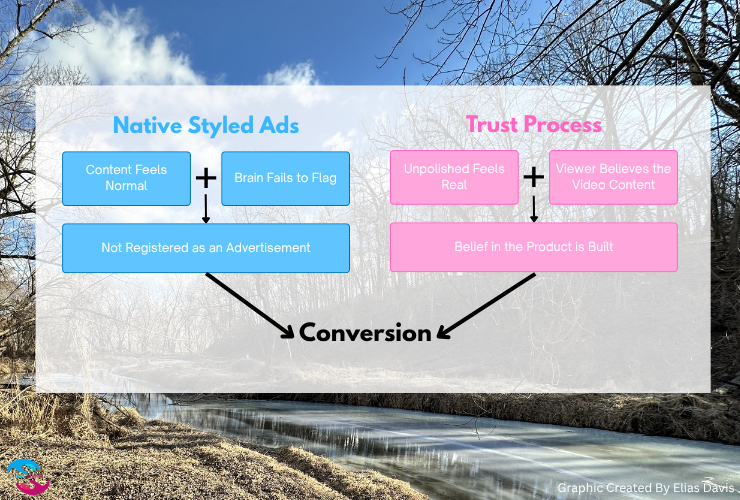
The first is what I think of as native friction. When content looks like it belongs on the platform, people don't brace against it. It fits the visual texture of the feed, so the brain doesn't flag it and the thumb doesn't move. You get two, three, five seconds of actual attention that the polished version never gets. In performance advertising, those extra seconds are where everything happens.
The second thing is trust. There's something about unpolished delivery that reads as genuine. When someone shows up on their phone looking slightly tired and talks straight into the camera, you believe them in a way you don't believe the model on the clean backdrop. This isn't a small effect. It's the difference between content people watch because they want to and content people recognize as an attempt to sell them something.
What You Should Actually Do
The goal here isn't to make bad creative. Low quality for its own sake doesn't work. What you're aiming for is content that looks like something a real person would actually post, which means it has to serve the viewer before it serves the brand.
In practice, that means opening with something worth watching: a specific result, a counterintuitive opinion, a problem the viewer recognizes in themselves. Get there before you mention the product. Use real spaces rather than neutral ones. Speak the way you actually speak. And resist the instinct to clean it up in post, because that's usually where the authenticity dies.
The format that's working best right now is the testimonial or reaction clip: someone in a real environment talking about a real experience. The reason it scales well is that the cost per creative is low and the one thing that makes it work, genuine human presence, can't be manufactured by spending more money.
Where Brands Get This Wrong
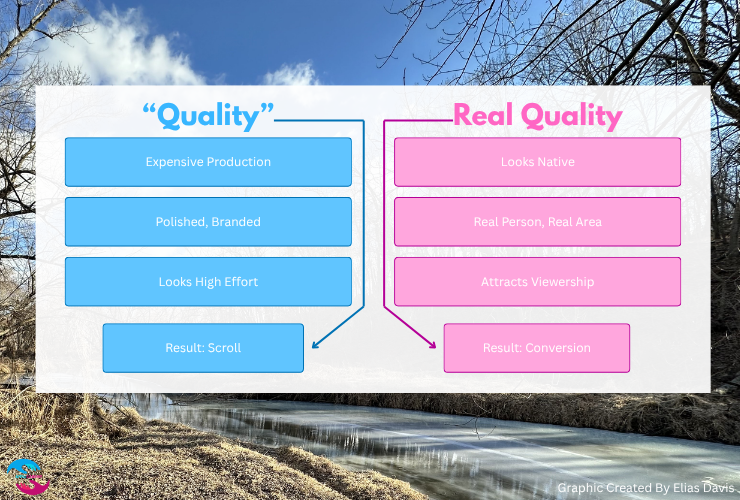
Most brands treat production spend as proof of creative quality. They spend more because spending more signals effort, to clients, to leadership, to themselves. Nobody asks whether the extra spend is actually serving the viewer or just making the ad easier to skip. A beautifully produced video that gets scrolled past has a ROAS of zero. A $200 clip that people stop and watch will beat it every time.
The other trap right now is AI-generated creative. And I get it, the speed and cost case is real. But audiences are getting fast at recognizing AI video and imagery. The smoothness, the slightly unnatural pacing, the quality that's technically perfect but somehow off, it trips the same alarm that polished production does. Sometimes faster. The thing that makes organic content work is human presence, and that's the one thing AI can't give you yet.
What a Good Ad Actually Is
A good ad is one that gets watched. That's it. Not one that looks impressive in a deck, not one that wins an award, not one that makes the production team proud. One that a real person, mid-scroll, actually stops for. Build your creative process around that standard and the metrics will follow.
Free Trial of Meta Ads
We offer a free trial of our Meta ads system, where I will create your content, manage the ads, and do it all before you pay me anything. Then, once it works and you want to continue, we move to a profit split.
If that sounds fair, fill out the form here: https://affilicademy.com/10freeugc
FAQ
Why do organic-style ads perform better than polished ones on social platforms?
Polished production triggers something close to automatic avoidance in most viewers. The visual cues that signal "this is an ad" are processed faster than conscious thought, and most people are already scrolling before they've made any real decision. Organic-style content sidesteps that response because it looks like the rest of the feed. The extra seconds of attention that buys are where click-throughs and conversions actually come from.
What does "native to the platform" mean in advertising creative?
It means the content looks like it belongs there. On TikTok, that's portrait video, casual delivery, on-screen text. On Instagram, it's posts that could have come from a personal account. The test is simple: if you removed the ad label, would someone scroll past it the same way they'd scroll past an organic post? If yes, you're in the right territory.
Is AI-generated creative actually a problem for performance advertisers right now?
It's becoming one. Recognition of AI-generated video and imagery is developing faster than most people expected, and the qualities that make AI output feel slightly off, the uncanny smoothness, the pacing, are enough to trip the ad-detection response in a lot of viewers. For campaigns that depend on organic authenticity, human-created content is still outperforming AI-generated alternatives, especially in the first few seconds.
How do you measure whether a creative is actually working or just getting impressions?
Hold rate, meaning the percentage of viewers still watching after three seconds, and watch time percentage are the most honest signals. A lot of impressions with a low hold rate means you're buying media against an audience that's already leaving. Pair those numbers with cost-per-click and conversion data and you'll get a clear picture of where the creative is failing.
Can brands keep messaging consistent if they're using raw, unscripted content?
Yes, but the approach changes. Scripts produce scripted delivery. What works better is a brief: here's the core message, here's what needs to come across, say it however feels natural to you. The messaging holds together and the delivery sounds like a human being, which is the whole point.
Does this approach work for every product category?
It works best when the product can be shown or talked about in a real context: physical goods, apps, supplements, services where someone can speak from personal experience. It's harder for abstract B2B products or anything where legal or compliance requirements lock down the language. Even then, the principle holds: genuine human delivery outperforms overproduced visual presentation, even when the words themselves are fixed.
Glossary
Ad Fatigue - full article
Ad fatigue occurs when an audience has seen the same creative repeatedly, leading to declining CTR and rising costs.
Algorithmic Optimization
The process by which Meta's delivery system learns from campaign data to show ads to users who are more likely to complete the desired action, such as a purchase or lead submission.
Broad Targeting - full article
An advertising configuration in which no manual audience filters — such as interests, demographics, or behaviors — are applied, allowing the algorithm to determine delivery based on its own user modeling.
CAC (Customer Acquisition Cost) - full article
CAC is the total cost required to acquire a new customer through advertising and marketing efforts.
Click-Through Rate (CTR) - full article
Click-through rate is the percentage of users who click on an ad after seeing it, indicating how compelling and relevant the ad is.
Conversion Rate - full article
Conversion rate is the percentage of users who take a desired action after clicking an ad, such as making a purchase.
Cost Per Acquisition (CPA) - full article
Cost per acquisition is the total cost required to generate a customer or conversion, combining traffic costs and conversion performance.
Cost Per Click (CPC) - full article
Cost per click is the average amount paid for each click, primarily influenced by CTR and CPM within the ad auction.
Cost Per Thousand Impressions (CPM) - full article
CPM is the cost to deliver 1,000 impressions, affected by competition, audience targeting, and engagement signals.
ICP- full article
Ideal Customer Profile, or the one person who your ads target specifically. This should be the perfect buyer for your product.
Learning Phase
The initial period of a Meta campaign during which the algorithm gathers data on user responses to optimize future delivery. Campaigns typically require a defined number of conversion events to exit this phase.
LTV (Lifetime Value)
LTV refers to the total revenue a customer generates over the duration of their relationship with a business.
LTV:CAC Ratio
This ratio compares customer value to acquisition cost and is used to determine whether marketing efforts are profitable.
LTGP (Lifetime Gross Profit)
LTGP measures the total profit generated by a customer after accounting for cost of goods sold over their lifetime.
Meta Ads - full article
Meta ads are paid advertisements run across platforms owned by Meta, including Facebook and Instagram.
Pixel Data
Behavioral data collected by Meta's tracking pixel installed on an advertiser's website, used by the algorithm to understand which types of users are most likely to convert.
ROAS (Return on Ad Spend) - full article
A performance metric calculated by dividing revenue generated from advertising by the total amount spent on those ads.
This article was written by Elias Michael Davis, the founder of Affilicademy.