The Highest Converting Ad Hook for Fitness Products on Meta Ads
The Visual Hook That's Been Winning Since Before You Were Running Ads
The best-performing fitness ad I've ever seen was grainy. Shot on what looked like a 2009 iPhone, bad lighting, someone's garage in the background. It wasn't designed. There was no motion graphic, no brand kit, no voiceover from a guy who sounds like he trains Navy SEALs.
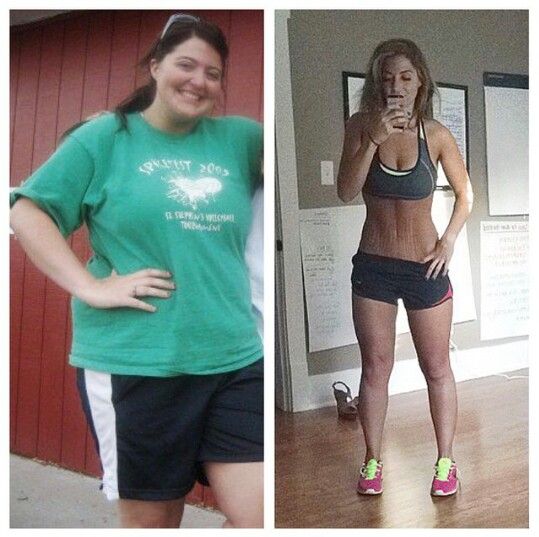
It was just a split image, left side, soft and uncomfortable. Right side, the same person, twelve weeks later, visibly changed. That ad ran for months. I know because I kept seeing it, and every time I did, I felt something.
That feeling is the mechanism. And understanding it is the only thing that actually matters when you're trying to write high converting ad hooks for fitness products on Meta.
This Article Has a Video Version!
If you want to watch rather than read, I filmed this video based on the article.
The Hook is a Mirror.
Most people, when they think about writing an ad hook, think about words. They're trying to find the right sentence, the right opening, the arresting phrase that stops the scroll. And for a lot of industries, that's where you should start. But fitness is different. Fitness is one of the few categories where the visual itself is the hook, and if you get the visual right, the words barely matter.
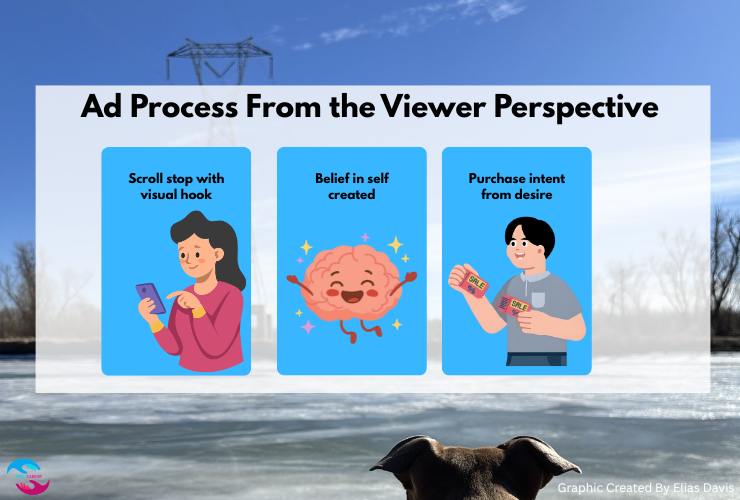
The reason is simple: most people don't want to understand fitness. When someone scrolling through Instagram sees a before-and-after that looks like them their brain doesn't process it as an advertisement. You have a chance.
What's Actually Going On With Before-and-Afters
I had a conversation with someone who thought before-and-after content was played out. Too obvious. Too 2015. He was running ads with stylized graphics and motivational copy and wondering why his cost-per-lead had crept up to a point that made the numbers not work.
I told him to pull one of his clients, shoot a simple split image, run it with four lines of text, and see what happened. He came back three weeks later and said it was his lowest CPA ever, by a significant margin.
Here's what that format does that almost nothing else does: it collapses time. In one image, you're showing the beginning and the end of a journey that takes months. That compression is powerful because it removes the biggest psychological barrier in fitness marketing, which is doubt about the process.
The format has been working since supplement ads were running in the back of magazines in the 90s.
The Difference Between a Good Hook and a Great One
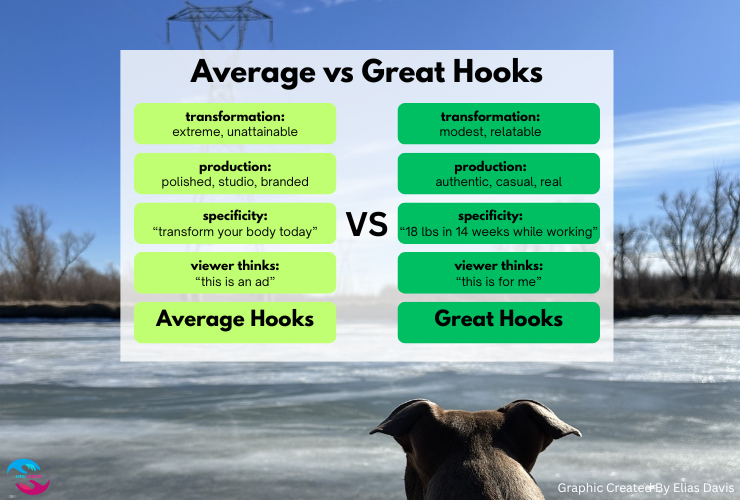
Not all before-and-afters are equal, and this is where most fitness advertisers leave performance on the table. The generic version, dramatic transformation, extreme results, professional lighting, actually performs worse than the version that looks more like your customer.
This sounds counterintuitive until you think about who's seeing the ad. If someone has forty pounds they want to lose and they see an ad featuring someone who dropped a hundred and twenty, the gap feels too large.
The best-performing fitness hooks show results that feel reachable. Real people, real settings, modest-to-meaningful transformations.
The other variable that separates good hooks from great ones is specificity in the copy that frames the image. Not "she lost 23 pounds" but "she lost 23 pounds in 14 weeks while working full time and never going to a gym." The detail does the work. It pre-answers the objections before the objections form.
You can make this even better by letting the person experiencing the product to say the line. "I lost 23 pounds in 14 weeks while working full time and raising my kids, without going to the gym." Now, it is personal, relatable, and shows someone with a normal life accomplishing a great result.
What You Should Actually Do
If you're running fitness ads and you don't have a strong before-and-after in rotation, that's the first test to run. Recruit a real client, get a real split image, write a single line of copy that names a specific detail about their situation, time frame, lifestyle constraint, something that makes it feel true, and run it against whatever you're currently running. The data will tell you what you need to know.
From there, the job is to iterate on the variables that affect believability: body type representation, time frame specificity, lifestyle detail in the copy, and how closely the transformation mirrors your actual buyer. Every adjustment to those four variables is a hypothesis. Run enough of them and you'll develop a clear picture of which version of the hook your specific audience responds to. That picture is more valuable than any framework.
Using visual hooks in the fitness space is an elite method. Use it.
Or, if you want a free trial with a performance based ad system where I will do it for you,
fill out the form here: https://affilicademy.com/10freeugc
FAQ
What makes an ad hook high converting for fitness products? A high converting hook immediately creates emotional resonance with the viewer's desired outcome. In fitness specifically, this almost always means showing the result visually rather than describing it in copy — a before-and-after image, a candid transformation, or a real person whose story mirrors the viewer's situation. The hook works when the viewer's instinctive response is "that could be me," not "that's impressive."
Are before-and-after images still effective in 2025 and 2026 Meta ads? They remain among the most consistently high-performing formats in fitness advertising because they address the viewer's core psychological need: proof that the result is real and achievable. The execution has evolved — authenticity and relatability now outperform dramatic or polished versions — but the underlying mechanism hasn't changed in decades.
What's the difference between an organic hook and a paid ad hook? Organic content can build to the hook over multiple seconds or even multiple posts because the audience has an existing relationship with the creator. A paid ad hook has to earn attention immediately from a stranger who didn't choose to see it. This means the first frame or image has to make the emotional argument before any copy is read. Organic can develop; paid must land.
Why does authentic-looking content outperform polished production in fitness ads? Polished, high-production ads signal "advertisement" the moment they appear, which triggers the automatic filtering behavior most social media users have developed. Authentic, casual content reads as peer content rather than promotional content, which allows it to pass through that filter. For fitness specifically, a real person in a real environment is also more believable than a model in a studio — and believability is what drives conversion.
How specific should the copy be in a fitness ad hook? Very specific. The copy that frames a visual hook should include concrete details: a time frame, a lifestyle constraint, a situation that mirrors the viewer's reality. "She lost 18 pounds while working night shifts" performs differently than "she lost 18 pounds" because the detail pre-handles objections and demonstrates that the offer understands the buyer's actual life, not just their desired outcome.
What's the biggest mistake fitness advertisers make with their hooks? Defaulting to extreme or aspirational transformations that feel out of reach for the average viewer. A result that looks too dramatic stops being evidence and starts being a highlight reel. The viewer's subconscious disqualifies themselves before they've considered the offer. Modest, believable, relatable transformations consistently outperform spectacular ones because they answer the question every viewer is quietly asking: could this work for someone like me?
Glossary
Ad Fatigue - full article
Ad fatigue occurs when an audience has seen the same creative repeatedly, leading to declining CTR and rising costs.
Algorithmic Optimization
The process by which Meta's delivery system learns from campaign data to show ads to users who are more likely to complete the desired action, such as a purchase or lead submission.
Broad Targeting - full article
An advertising configuration in which no manual audience filters — such as interests, demographics, or behaviors — are applied, allowing the algorithm to determine delivery based on its own user modeling.
CAC (Customer Acquisition Cost) - full article
CAC is the total cost required to acquire a new customer through advertising and marketing efforts.
Click-Through Rate (CTR) - full article
Click-through rate is the percentage of users who click on an ad after seeing it, indicating how compelling and relevant the ad is.
Conversion Rate - full article
Conversion rate is the percentage of users who take a desired action after clicking an ad, such as making a purchase.
Cost Per Acquisition (CPA) - full article
Cost per acquisition is the total cost required to generate a customer or conversion, combining traffic costs and conversion performance.
Cost Per Click (CPC) - full article
Cost per click is the average amount paid for each click, primarily influenced by CTR and CPM within the ad auction.
Cost Per Thousand Impressions (CPM) - full article
CPM is the cost to deliver 1,000 impressions, affected by competition, audience targeting, and engagement signals.
ICP- full article
Ideal Customer Profile, or the one person who your ads target specifically. This should be the perfect buyer for your product.
Learning Phase
The initial period of a Meta campaign during which the algorithm gathers data on user responses to optimize future delivery. Campaigns typically require a defined number of conversion events to exit this phase.
LTV (Lifetime Value)
LTV refers to the total revenue a customer generates over the duration of their relationship with a business.
LTV:CAC Ratio
This ratio compares customer value to acquisition cost and is used to determine whether marketing efforts are profitable.
LTGP (Lifetime Gross Profit)
LTGP measures the total profit generated by a customer after accounting for cost of goods sold over their lifetime.
Meta Ads - full article
Meta ads are paid advertisements run across platforms owned by Meta, including Facebook and Instagram.
Pixel Data
Behavioral data collected by Meta's tracking pixel installed on an advertiser's website, used by the algorithm to understand which types of users are most likely to convert.
ROAS (Return on Ad Spend) - full article
A performance metric calculated by dividing revenue generated from advertising by the total amount spent on those ads.