
Winning Meta Ads - What, How, Why.
What Is a Winning Meta Ad? (And Why Most People Define It Wrong)
Video version for those who prefer to watch instead of read:
Most people think a winning Meta ad is the one with the highest ROAS.
I know. Sounds obvious. But it’s wrong.
I learned this the hard way in 2021. I was running a campaign for a small subscription brand in Des Moines. Ad A was crushing it in the dashboard, 3.5 ROAS. Ad B was a “loser” at 2.1. Naturally, I started pouring spend into Ad A and ignored Ad B.
Two months later, Ad A brought in one-off buyers who never returned. Ad B? Those customers came back. They bought more. Over 90 days, Ad B made twice the profit. I had been chasing a number that meant nothing.
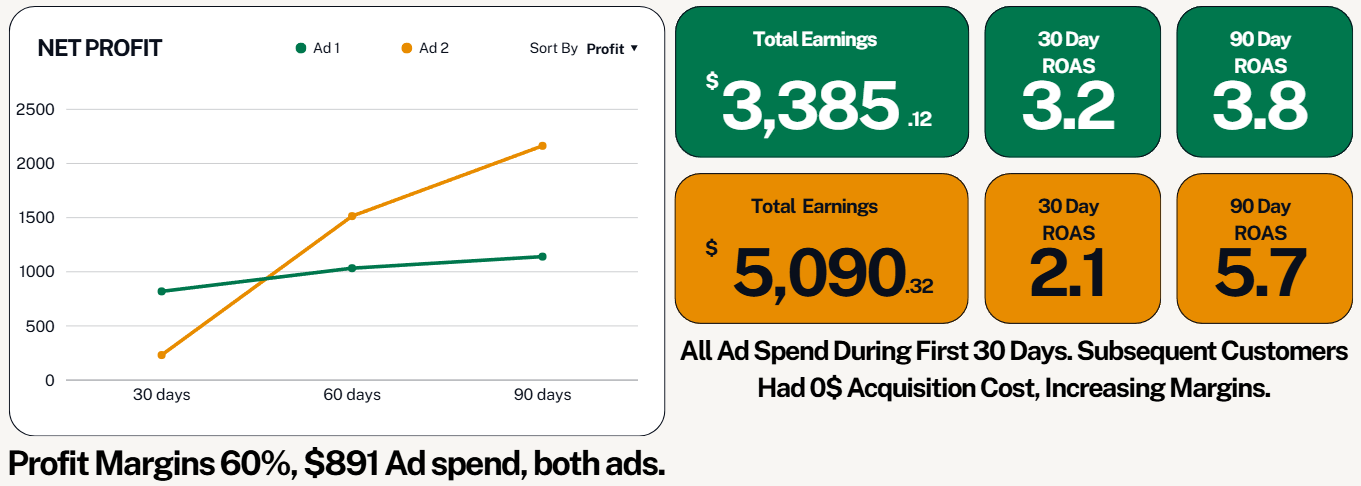
A winning ad is an ad that hits a pre-defined goal
Sometimes that goal is profitability within 30 days. Sometimes it’s awareness. Sometimes it’s penetration into a new audience. Or cost per lead. The key is deciding before you run anything what matters.
Meta doesn’t know what your goal is. It optimizes for conversions or awareness.
I used to think a “winning ad” was one that looked good in the first week. But I’ve seen ads that start slow, perform poorly at small budgets, and then crush it once they scale. You can’t judge too early.
If your business needs profitability in 30 days, your winning ad is the one that meets your 30-day LTV:CAC target.
If your business can wait 90 days or longer, winning ads are the ones that maximize lifetime gross profit relative to acquisition cost.
I remember testing this with a boutique skincare brand in Chicago. One ad had an early 2.0 ROAS, another 3.0. The 3.0 ad looked better at first glance. But the 2.0 ad brought in repeat buyers who spent more on their second and third purchases. Over 120 days, the “losing” ad outperformed everything else.
This is why metrics like ROAS within the ad manager are surface-level.
Here’s the system I follow now:
Start with your 30-day LTV:CAC.
Take your average order value, subtract all costs. That’s your max CAC. Any ad that acquires customers below that cost is a potential winner.
The reason you use 30 days for this is so you can use revolving lines of credit, credit cards, or your own cash, and quickly make it back so you do not run into cash crunches. I hate those.
Then layer in the longer-term view. LTGP:CAC tells you which ads will scale profitably over time. Some ads won’t look profitable immediately. But if the numbers are right, they outperform everything else in the long run.
I ran a test for an e-commerce client last year. We had three ads. One hit our 30-day break-even target immediately. One didn’t, but showed strong second purchase behavior. The third was a clear loser.
If I had only scaled the first ad, we would have left 40% of total profit on the table. By layering in LTGP:CAC, we knew which ad to trust for long-term scaling.
How Much Difference Do Ad Formats Make?
Formats matter less than most people think. Image, video, carousel, collection are all just delivery mechanisms.
I’ve seen carousel ads outperform video ads and vice versa. The format doesn’t decide profitability.
If your ad creative doesn’t hit the right audience with the right message, no format will save it.
Here’s another story. I was testing a carousel ad for a supplement brand. Engagement was low, CTR below average. Meta metrics looked like a failure.
That ad ended up being one of the highest LTGP:CAC performers in the campaign.
The people who purchased would almost always buy 3 months worth of the supplement immediately, and then were rolled into a subscription.
Shawn, the owner of that store, just sold it to a P.E. firm in January and walked away with a check more than a million dollars from ads that you would think would fail.
As a side note, this supplement specifically targeting women who were experiencing the negative impacts of aging on your body, and had creatine as the recommended solution. All of the ads centered around verifiable studies on how your bodies ability to gain muscle massively improves while using creatine.
This was a very specific ICP, and leveraged awareness-first advertising to increase results.
(Ads like the one shown below)

What is the Secret Formula?
There’s no secret formula for winning Meta ads. No creative hack or hook that works every time.
What separates good accounts from great accounts is clarity.
Clarity on the numbers. Clarity on thresholds. Discipline to only scale what meets them.
Everything else, angles, hooks, creatives, exists to serve that clarity.
Mistakes I see all the time:
Scaling too early. An ad might look strong in the first thousand impressions and flop at scale.
Confusing engagement with economics. High CTR doesn’t mean profit. High conversions don’t mean the customers are valuable.
Here’s a simple principle I follow: a winning Meta ad is an asset that acquires customers at a cost that aligns with your business model. Short-term and long-term.
Still Struggling With Creating Ads?
I create ads on a performance basis, with a free trial, for qualified businesses with the link below. Check it out!
https://affilicademy.com/10freeugc
FAQ
What is a winning Meta ad in simple terms?
A winning Meta ad is one that acquires customers at a cost that meets your predefined profitability threshold. This usually means aligning CAC with your 30-day or lifetime customer value. If the economics work, the ad is a winner.
How to create winning Meta ads consistently?
You create winning Meta ads by testing different creative angles and messages against a fixed performance benchmark. Instead of chasing engagement metrics, you evaluate ads based on whether they hit your LTV:CAC targets. Consistency comes from volume and disciplined evaluation.
Is a 2.5 ROAS good for Meta ads?
A 2.5 ROAS can be good or bad depending on your margins and customer lifetime value. If your business is profitable at that level, it’s strong. If your cost structure requires a higher return, it’s not sufficient.
What are the types of Meta ads available?
Meta offers several ad formats including image ads, video ads, carousel ads, and collection ads. These formats affect how your message is delivered, but they don’t determine whether an ad is profitable.
Is there any secret to Meta ads that top advertisers use?
There is no hidden trick, top advertisers define clear profitability benchmarks and test aggressively. They scale only the ads that meet those benchmarks and ignore everything else.
Glossary
CAC (Customer Acquisition Cost)
CAC is the total cost required to acquire a new customer through advertising and marketing efforts.
LTV (Lifetime Value)
LTV refers to the total revenue a customer generates over the duration of their relationship with a business.
LTV:CAC Ratio
This ratio compares customer value to acquisition cost and is used to determine whether marketing efforts are profitable.
LTGP (Lifetime Gross Profit)
LTGP measures the total profit generated by a customer after accounting for cost of goods sold over their lifetime.
Meta Ads - full article
Meta ads are paid advertisements run across platforms owned by Meta, including Facebook and Instagram.
ROAS (Return on Ad Spend)
ROAS is a metric that measures revenue generated for every dollar spent on advertising.
Click-Through Rate (CTR) - full article
Click-through rate is the percentage of users who click on an ad after seeing it, indicating how compelling and relevant the ad is.
Cost Per Acquisition (CPA) - full article
Cost per acquisition is the total cost required to generate a customer or conversion, combining traffic costs and conversion performance.
Cost Per Click (CPC) - full article
Cost per click is the average amount paid for each click, primarily influenced by CTR and CPM within the ad auction.
Cost Per Thousand Impressions (CPM) - full article
CPM is the cost to deliver 1,000 impressions, affected by competition, audience targeting, and engagement signals.
Conversion Rate - full article
Conversion rate is the percentage of users who take a desired action after clicking an ad, such as making a purchase.
Ad Fatigue - full article
Ad fatigue occurs when an audience has seen the same creative repeatedly, leading to declining CTR and rising costs.
ICP- full article
Ideal Customer Profile, or the one person who your ads target specifically. This should be the perfect buyer for your product.