This is Why ICP is so Much Better than Target Market
Why Is ICP the Best Way to Target for Meta Ads (and more)
The problem with developing an ICP for most people is they feel they do not have enough data to know who will pay the most or be the most profitable. Now, if you do, that makes it easy, but you don't actually need it.
Just imagine a specific person within your market, what their problems are, motivations, and goals. The point is to make the best educated guess that you can, so that you can create compelling advertising. If you try to address the whole market, you are addressing nobody.
This is the process I use to develop ICP, and how it has benefited my business.
This Article Has a Video Version!
For those who prefer to watch instead of read, I filmed this on my primary YouTube channel.
You Don't Need to "Find" Your ICP. You Need to Pick One and Aim.
Most people treat the ICP like a research project. They want surveys, customer interviews, cohort analysis, and a bunch more, before they feel confident enough to run a single ad. I understand the impulse. It feels responsible. But here's the thing: if you're a startup, or you're early in a new market, or you have less than 500 lifetime customers, that approach will kill your momentum before you ever get real data (if you even can find the data.)
I know that sounds like permission to be sloppy. It isn't. You still need to make a great ICP. This is how.

The Mistake I See Over and Over
I was working with a founder a while back - SaaS product, small team - and they'd been running Meta ads for about three months without meaningful results. When I looked at their campaigns, the messaging was all over the place.
One ad spoke to HR managers, another to solo operators, a third to mid-market ops teams. Each one was reasonable on its own. Together, they were a mess. The algorithm didn't know who to optimize toward, the creative couldn't develop any real resonance, and the team kept chasing the next test instead of deepening what was already working. They were trying to figure out their ICP by advertising to everyone at once.
The idea was to research with market responded best, but the problem was the budget. Advertising with a budget of $100/day trying to hit 10 different ICPs and 5 problem statements just will not work.
I recommended reducing to the strongest ICP based on how impactful the problem was, and ad results became profitable in less than 2 weeks.
What the ICP Is Actually For (At This Stage)
When you're early on Meta, in a new vertical, with a new offer, the ICP is about having a target to aim at. That's the whole job. A specific person gives your creative a direction. It gives your copy a voice. It gives the algorithm a signal. Without that specificity, everything you build is vague, and vague doesn't convert.
Startups and early-stage advertisers fail at a predictable rate when they try to address the whole market from the start. What happens isn't that they spread the budget thin, that's the obvious problem.
The deeper damage is in the product. When you're trying to serve three different ICPs simultaneously, you end up scrambling to build features that satisfy a rotating cast of niche clients, and you end up serving none of them particularly well.
The messaging gets watered down, the roadmap gets fractured, and six months later you're back to zero trying to figure out who you actually built this for.
Making the Informed Bet
The right move is to make an informed bet. You probably already have some information: who clicked on your early content, who asked for the demo, who replied to your cold outreach first.
You don't need a hundred interviews to know that your early traction is skewing toward a particular kind of person. Pick that person. Write them down specifically, not "marketing managers" but "marketing managers at bootstrapped e-commerce brands doing $1M–$5M in revenue who are running ads themselves and are tired of inconsistent ROAS." That level of specificity is what makes the ad creative actually land.
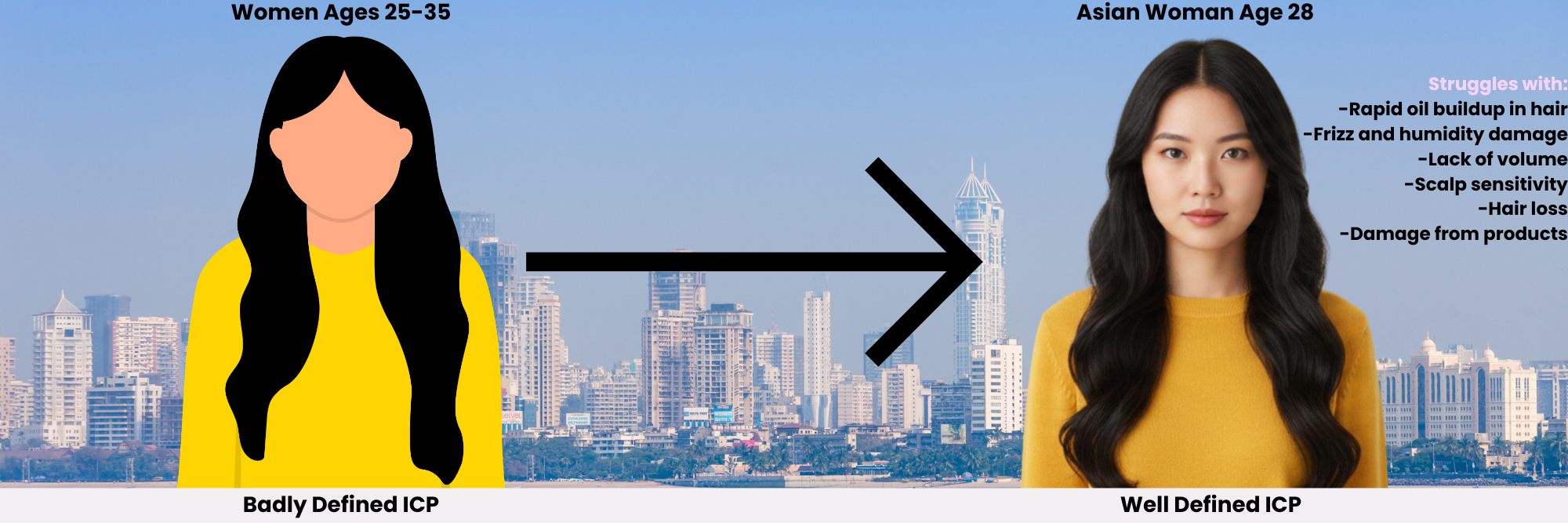
Then you aim everything at them. Your copy, your creative hooks, your offer framing, your landing page, all of it built for that one person. This is what gives Meta's algorithm enough of a signal to go find more of them.
The more coherent your targeting ICP is, the better Andromeda can build its probability map around who's converting, and the more efficiently it delivers to the right people first.
What You Learn, and How to Adjust
Here's the part that doesn't get said enough: you're not locked in. Picking an ICP and committing to it isn't a permanent decision, it is somewhere you can start and build off of. You run at that target hard, you write down everything you observe, and you pay attention to who actually converts versus who you thought would.
Sometimes the ads you built for marketing managers get clicked by founders. Sometimes the copy you wrote for solo operators resonates most with agency owners. That data is gold, but you only get it if you committed to a direction in the first place. You can't learn who actually buys if you're running unfocused messaging at a diffuse audience.
The discipline here is to not chase every signal at once. When you start seeing results from an unexpected segment, don't immediately pivot, note it, test it deliberately, and see if it holds. This is how the ICP evolves over time without losing the coherence that was making things work.
Targeting on Meta Isn't Separate From This
On Meta specifically, your ICP shaping is happening at the creative level more than the audience settings level. Broad targeting, which is Meta's current recommended configuration, puts the ICP work squarely in the hands of your ad creative. The algorithm reads the signals in your video, your copy, your hook, and uses those to determine who to show it to.
If your creative is built for a specific person, Andromeda will find more of that person. If your creative is built for everyone, Andromeda doesn't have enough signal to optimize intelligently, and you end up paying for impressions across a cold, unfocused audience.
This is why the ICP has to come before the creative brief, not after. You define the person, then build everything from there.
The Strategic Takeaway
You need to make the most informed bet you can right now, build your creative around that specific person, and run at them with focus. Then you pay attention to what happens. The ICP sharpens through action, not through preparation. Pick the target, put all your energy into aiming at it, write down what you learn, and adjust from there. That's the whole process.
The Best New for Business Owners
If you are tired of high costs, a free trial is probably just what you need. I will run all of your ads, and then, once you get great results, we switch to a performance basis. Split the sales. 0 cost up front.
Learn more here:https://affilicademy.com/10freeugc
FAQ
What is an ICP in the context of Meta ads? ICP stands for Ideal Customer Profile — a specific description of the person your ads are built to reach. On Meta, where broad targeting is increasingly the default, the ICP functions primarily through your creative. The algorithm reads the signals in your ad and finds users who match the behavioral and interest patterns implied by the content. Defining a clear ICP before writing any creative is what gives the algorithm something useful to optimize toward.
What's the difference between an ICP and a target market? A target market is a broad category — "small business owners" or "women aged 25–45 interested in fitness." An ICP is a specific individual within that category: their role, their frustrations, their goals, the decision they're currently trying to make, and why your offer matters to them right now. Target markets define the pool. The ICP is the person you're writing to. On Meta, the ICP is what makes your creative coherent enough to convert.
Is the ICP the best targeting method for Meta ads? For early-stage advertisers and startups, the ICP is less about technical targeting configuration and more about messaging focus. You can run broad targeting — no interest or demographic filters — and still reach the right people if your creative is built for a specific person. The ICP shapes the ad, and the ad shapes who the algorithm delivers to. In that sense, the ICP is not a targeting method so much as the foundation that makes any targeting method work properly.
How do I develop an ICP if I don't have customer data yet? You don't need complete data to make a starting ICP — you need the best available signal. Look at who engaged with your early content, who responded to outreach, who asked for a demo first. Even a small number of early interactions contains patterns. From there, make an informed bet: write down a specific person with a specific role, specific frustrations, and specific goals, then build your first campaign around them. The ICP develops through the data you collect after you commit to a direction.
Why does unfocused Meta ads targeting hurt performance? When your creative is built for multiple different audiences simultaneously, it sends mixed signals to Meta's delivery algorithm. Andromeda can't build a coherent probability map around who to target, so it distributes impressions broadly and inefficiently. You get low-intent traffic, high CPAs, and no clear pattern to learn from. The deeper cost is that your creative can't build resonance with any specific person — and resonance is what drives conversions.
How often should I revisit or update my ICP? Treat the ICP as a living document tied to your campaign data. The initial ICP is a hypothesis; every campaign is a test of that hypothesis. Review it whenever a meaningful segment of unexpected converters appears, when CPA shifts significantly across different audience segments, or when you introduce new creative and notice a change in who's engaging. The goal isn't to change the ICP constantly — it's to sharpen it deliberately based on what the data actually shows.
Glossary
Ad Fatigue - full article
Ad fatigue occurs when an audience has seen the same creative repeatedly, leading to declining CTR and rising costs.
Algorithmic Optimization
The process by which Meta's delivery system learns from campaign data to show ads to users who are more likely to complete the desired action, such as a purchase or lead submission.
Broad Targeting - full article
An advertising configuration in which no manual audience filters — such as interests, demographics, or behaviors — are applied, allowing the algorithm to determine delivery based on its own user modeling.
CAC (Customer Acquisition Cost) - full article
CAC is the total cost required to acquire a new customer through advertising and marketing efforts.
Click-Through Rate (CTR) - full article
Click-through rate is the percentage of users who click on an ad after seeing it, indicating how compelling and relevant the ad is.
Conversion Rate - full article
Conversion rate is the percentage of users who take a desired action after clicking an ad, such as making a purchase.
Cost Per Acquisition (CPA) - full article
Cost per acquisition is the total cost required to generate a customer or conversion, combining traffic costs and conversion performance.
Cost Per Click (CPC) - full article
Cost per click is the average amount paid for each click, primarily influenced by CTR and CPM within the ad auction.
Cost Per Thousand Impressions (CPM) - full article
CPM is the cost to deliver 1,000 impressions, affected by competition, audience targeting, and engagement signals.
ICP- full article
Ideal Customer Profile, or the one person who your ads target specifically. This should be the perfect buyer for your product.
Learning Phase
The initial period of a Meta campaign during which the algorithm gathers data on user responses to optimize future delivery. Campaigns typically require a defined number of conversion events to exit this phase.
LTV (Lifetime Value)
LTV refers to the total revenue a customer generates over the duration of their relationship with a business.
LTV:CAC Ratio
This ratio compares customer value to acquisition cost and is used to determine whether marketing efforts are profitable.
LTGP (Lifetime Gross Profit)
LTGP measures the total profit generated by a customer after accounting for cost of goods sold over their lifetime.
Meta Ads - full article
Meta ads are paid advertisements run across platforms owned by Meta, including Facebook and Instagram.
Pixel Data
Behavioral data collected by Meta's tracking pixel installed on an advertiser's website, used by the algorithm to understand which types of users are most likely to convert.
ROAS (Return on Ad Spend) -full article
A performance metric calculated by dividing revenue generated from advertising by the total amount spent on those ads.